
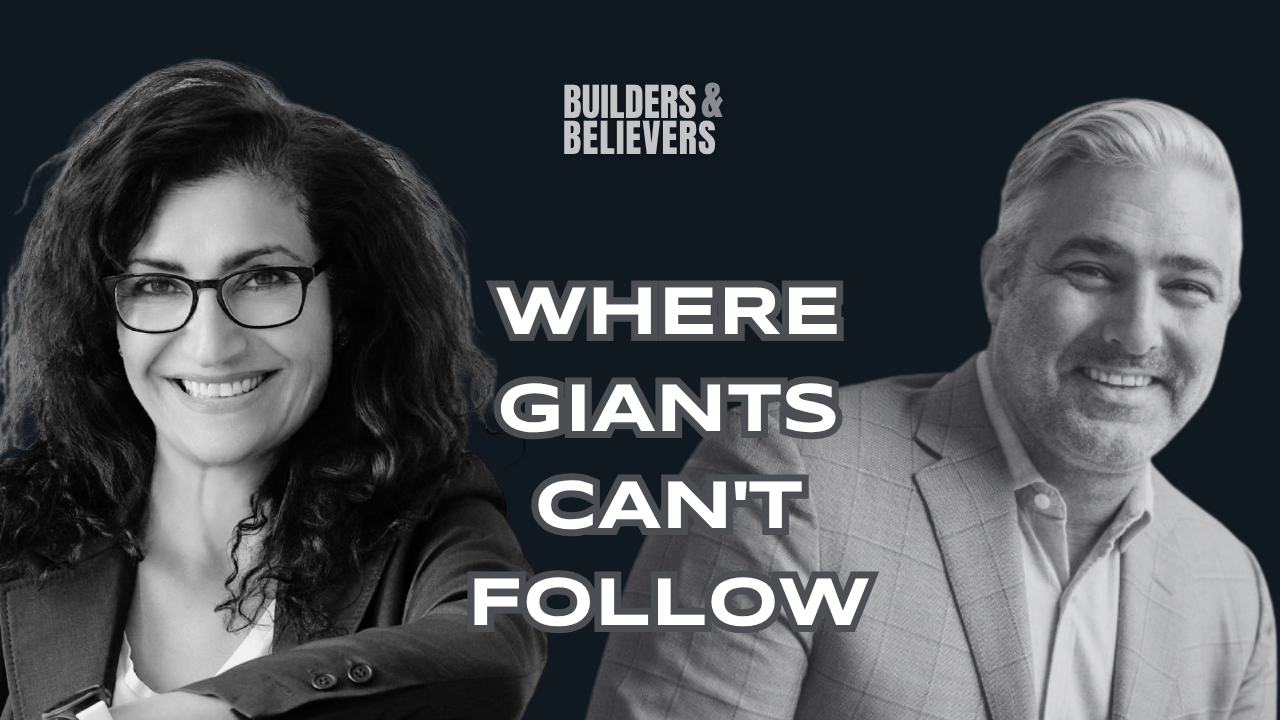

From Epiphany to Enterprise: How Flow Built Conviction in a Category Ruled by GiantsWhat does it take to challenge an entrenched industry without losing conviction along the way?
In this episode of Builders & Believers, Amanda Stassen sits down with Nicholas Reichenbach, founder of Flow MineralWater, to explore the ideas and real decisions behind building a premium water brand in a category dominated by global giants.
What began as a personal awakening evolved into a boldbet on sustainability, brand, and belief, long before the $100M IPO outcome was clear. Nicholas shares what it looked like to build and lead while the path was still unfolding, through skepticism and pressures, all while staying true to Flow’smission, ultimately growing into one of the fastest-growing premium water brands in North America.
You’ll hear how Nicholas navigated:
Choosing conviction over convention in a highly competitive category
Building a sustainability-led brand before it was mainstream
Scaling without compromising trust or authenticity
Making strategic bets when the incumbents controlled the landscape
Because building something that matters takes both thebuilder and the believer.
Learn more about Flow Mineral Water at www.flowhydration.com
***
If this conversation resonated, follow Builders & Believers for more candid discussions exploring what it really takes to build, scale, and lead.
Builders & Believers with Amanda Stassen is created by BIZU Innovation, a strategic brand and creative partner tofounders and senior leaders building growth and impact.
Enjoyed this Episode?
Subscribe and share it with your friends, and don’t forget to follow us on INSTAGRAM, FACEBOOK and LINKEDIN.
Post a review and share it! If you enjoyed tuning in and learned something new, leave us a review. You can also share this with your friends and family to raise awareness about why we need sustainable food systems in a modern era.
Have any questions? Or want to share what resonated with you? Do you have any episode ideas or guest suggestions? Drop us a line at info@bizu.co
Let’s Talk. If your ready to grow your business into a profitable brand that matters, and adds value to people’s lives, let’s talk at www.bizu.co
Episode Transcription
0:00:33 Amanda Stassen: Welcome to Builders and believers, the show about what it really takes to build a business that moves people and makes a difference. I'm Amanda Stassen, strategic growth advisor and founder of Beazer Innovation, where I help leaders scale with clarity, conviction, and courage. Here we're going to go beyond business as usual to unpack the strategy, mindset and leadership it takes to build companies that perform with purpose and lead with heart.
Because building something that matters takes both the builder and the believer. Today we're talking about plastics and water. Now, most Canadians, including myself, believe that we're being environmentally conscious by sorting our plastics into the blue bins. But the truth is, less than 10% of those plastics are actually recycled. In fact, 50% of single use bottled plastic water bottles, even the recyclable ones go into landfills, where apparently each bottle takes about 450 years to decompose.
But here's another level of concern. There was a new study that was done by the National Academy of Science that analyzed bottle water from three different U.S. brands and found an average of 240,000 plastic particles, nanoparticles per liter, leaching out from the from the bottled water into what we're drinking. That's nano plastic that we're drinking. Now, can business help solve that problem I believe.
Absolutely and how? That's the challenge. Especially in a crowded and very competitive market like bottled water. And that's mostly run by really big players. Can you take on the really big players? The answer is yes. The how is what we're going to dive into today with Nicholas Rich and embark serial entrepreneur, founder, chairman and CEO of Flow Mineral Water, a B Corp company, on a mission to reduce environmental impacts by providing sustainably sourced, naturally occurring alkaline spring water in a recyclable and up to 75% renewable plant based stock.
Now, I'm so excited to dive into the story behind the flow brand, and especially how Nicholas transformed an epiphany that he had at the Burning Man Festival into a $100 million IPO and the fastest growing premium water company in North America. Let's get to it. It's so awesome to have you on the show, Nicholas. Thank you so much for being here.
0:02:55 Nicholas Reichenbach: Thank you.
0:02:55 Amanda Stassen: Yeah. I listen, the last time that we that I, that we had a conversation, we were like chatting at a Jackman, sort of. I think it was like a lunch and learn. And I loved your story when I heard it the first time. And I was like, dude, we got to get this guy on the podcast.
We got to dig into this story. I think it would be such an inspiration for people to hear how the genesis of Flow Water came, and I think it's really important for people to hear where these ideas come from. So let's start at the beginning. Let's start at the beginning. Take me back way back when. Take me back to Burning Man.
Like take me back to burning Man.
0:03:35 Nicholas Reichenbach: Well, I can even go further back.
0:03:38 Amanda Stassen: Okay. Do it, do it.
0:03:40 Nicholas Reichenbach: You know the genesis of flow, came from my family owning a very large artesian mineral water spring, in south Bruce County, in Ontario, Canada. Yeah. And I grew up on that spring, so I've been exclusively drinking flow, since I was born with pre packaging.
Yeah. Pretty packaging. And, it's a beautiful property. 25 acre property with this artesian spring. That's extremely unique, geographically, to the to to North America. Yeah. We're one of the only mineral water springs that, exist in North America. We own, another one in Virginia that we luckily found.
That's a whole other story. And so water was, you know, kind of in my DNA, from the start. Yeah. My father, was one of the founders of one of the first bottled water companies in Canada. Back in 1981, he started for most, a springs water company. Okay. And he took an old beer factory, and he converted it into a glass bottling line.
The compete against Avion and Perrier. The two. Only the two companies in the world that were selling water in, glass, bottles in Canada. And, so growing up in a very small town, mildly Ontario, I'm very proud of, you know, I remember water and the and being around me all the time. And my father starting one of the first bottled water companies and was really I got to see that a very influential age.
You know, I think it was I was eight years old. At the time. And we went through that whole process of him launching, a bottled water board and still in sparkling, and having guests over to the house all the time, big parties. And I remember that night, you know, I always had it in the back of my mind, that I wanted to start a water company.
And now, as the story goes, I was a concert promoter for the first ten years of my, career. 88 years old, aging myself. And, I approached my father to do, a bottled water company to, sell into all of the, concert venues and nightclubs and, on premise and, on premise strategy.
And at that time, he had sold the glass, bottled water company and, and they converted it back to a beer factory. It still exists. Most springs beer. That's, using that water. And, he never wanted to commercially develop this property because it's off the grid. Right? Beautiful artesian conditions called Blue Lake Springs. And, it produces, like, a high quality water.
But he's a conservationist, so he didn't want a factory. And at that time, it switched from glass to plastic. Okay. And, I approached him. I wrote a whole business plan. I remember it was on my fourth year international, commerce program degree, and, I wrote this whole business plan about how we could take bottled water and put it in private label, for all of these concert promotions, concert venues across North America.
And, I did the first sentence, coming out of my mouth and he said, over my dead body. That sounds like a dad, holding a dead body. Are you going to be a are you going to build a plastic factory in my hometown? Not a chance. I was like, oh my God. So I didn't even.
I printed this up at Kinko's at the time, a beautiful, like, tech business plan with financials and all that stuff. And I didn't have the heart to tell them. They even wrote a business plan. I just said, well, that didn't go so hot. And then I actually, moved into being the first Red bull distributor in North America.
Okay. Kind of pushed me into. Well, if we're not going to sell water, we're going to sell energy. At the time, and I did a deal with the Thai family to bring Red bull into North America, and I distributed it successfully for almost seven years before Clouse came in with the Red bull can. In, the early 2000 into North America.
And I realized I was like, okay, this is the this isn't going to go well. So we actually wrote him a letter and everything saying we would take the rights to, Red Bull in North America. And he wrote back and, this was before emails. Yeah. And he wrote back a letter, and my partner still has it today saying, as soon as that the taurine becomes legal, that we could distribute it and, well, as the story goes, I sold the company in 2001.
And so we never really we stopped distributing Red bull. And, so I got cut in, early age into beverage, and really enjoyed it. And, clearly couldn't, develop a water company at that time. And then fast forward, 2005, I was living in Europe and skiing Scandinavia and Sweden. And I was on a business trip, and, I was a tech entrepreneur.
I guess I am still technically, but, but I haven't done, I haven't started any tech companies since, I started flow ten years ago, and, we were we were, you know, in Norway, and I saw this beautiful cylinder bottle called Voss. So I drank and I was like, oh, this is great. I emptied it out.
And when I moved back, to Canada in 2005, I approached him again and said, I think we could do something really great in glass. It doesn't have the plastic, factory. And, we can do a premium product on premise, right? In restaurants and clubs and all that stuff. And he said, look, I'm going to be dead soon, and you could do whatever you want when I die.
Oh, and, and, I was like, I'm in progress. I'm making progress here. I sell that idea, and continue down my, tech path. And I made video games at the time, and, I, you know, continued to successfully publish video games all the way up to, having moved to New York and then San Francisco, and after selling one of my companies, I was kind of faced with what am I going to do next?
And, you know, I had, I think two days, went by after I resigned from, you know, got resigned from the board of the company, and, I was off my, golden parachute, as they say. Yeah. And, I was like, oh, my God, I got to get a job and, moping around my condo for two days, and my wife said, what?
What are you doing? Like, yeah, you're not going to get a job. You ever did a job, ever. And she's known me for a long time, almost 30 years. And she's from the same area, the same county she grew up with. Wow. Within. Within five miles, from me. And within 2.5 miles from the spring. So she's actually it.
The spring was in between us. Wow. And, she said you're not going to get a job. And I said, okay. And I guess I'm not going to get a job that I'm going to be a perpetual, you know, serial entrepreneur for the rest of my life. Right? And my, one of my old roommates. But I lived in London, England, was living in San Francisco, too.
And he said, well, you know, if you want an epiphany, people go to Burning Man. I'm like, Burning Man. What's that? He said, it's a festival in the middle of the desert, where you, you know, go and see art and experience life and all this stuff. So, of course, I went to Burning Man with him that year, 2013, together with, camp from the UK.
And at the end of, you know, being dehydrated, drinking five, 4 or 5l of water a day. And I drank avion at the time. And there's a reason for that. It's very similar to flow, and it's a 200 year old multi-billion dollar brand and company. And, at the end of the, at the end of the week, I discovered there was two things I didn't like about water premium water.
One is in plastic. And before even an article was written on the internet, I tasted microplastics in the water. And it that made it real. Taste. I'm like, oh, my God, this can't be good for you because it's the desert and heats up water and all that stuff. And, and then the second thing, when I went to recycle all the plastic bottles, they do it all round the cell phone tower.
And, I was like, looked at, how? Mountain of plastic. It was 70,000 people, seven days, you know, 2 to 3l. Four liters? Yeah. It was gigantic. Yeah. And I just looked, I said, oh, my God, this is an environmental disaster. Yeah. Yeah. Got to be a better way. Yeah. There's got to be a compostable, package made from renewable resources.
Yeah. Hold premium water that doesn't see sunlight or air. So it keeps the quality of the flow. Taste. And that was the epitome. Boom flow was born.
0:13:37 Amanda Stassen: Okay. So so let me jump ever since. Yeah. Let me, let me just pause for a second because I want to just hover on this idea of where you were you a man in search of a problem or did the problem find you?
And I ask it this way because your friend said to you, if you wanted to epiphany, go to Burning Man. Now, not everybody can go to Burning Man. No, but everybody can be open to, you know, something coming into their mind as an inspiration. Talk a little bit about just kind of a state of mind that you were in that allowed you to see and connect a problem with a solution.
Like Burning Man is amazing. I've never been, but I've heard it's pretty awesome and pretty radical. But, you know, there's there's a state of mind that you were in, and I, I'm so desperately wanting to call it the flow state, but I'm not going to
0:14:32 Nicholas Reichenbach: it's a flow state. So the whole state, Amanda, that's what it is.
0:14:36 Amanda Stassen: It is it it is.
Call it what it is. So but you were in that state. So talk a little bit about this. How were you a man looking for a problem or did the problem find you because you were in that state?
0:14:51 Nicholas Reichenbach: Yeah. So, I would say the problem found me because I was in that state, and I am in the flow state, almost every day.
Yeah. Flow. And there's there's reasons for that. I'm very passionate about, what we do. I get a lot of, enjoy in pride of what what we do to. And it feels like every day I'm surfing a wave. You know what I mean? Wave is positivity, right? Like, it's it's. We're doing something really good for the planet.
But, yeah, I'm sharing my beautiful family's artesian mineral water spring to the rest of the world. Yeah. And at the same time, we're having a positive impact. So I feel like I'm on my flow wave. Yeah. And in the flow state. But, you know, it's funny when you look at all the companies I've done in the past 30 years, they're all exactly the same, issues, and they're all the same.
They're all the same directional, directional, problem that I'm solving, which which is I've always invested in consumer products. Okay. So, like, I don't think I've ever invested in a non consumer product. And so I've been really focused on consumer intention and consumer intention to purchase. And consumer intention to purchase always lags from where the market is.
They, you know, consumers are kind of saying, hey, you know what? I really don't like drinking out of plastic. But then that doesn't change Coca-Cola's opinion of plastic or mass, position or Avion or anyone else's position because they've invested in all this infrastructure, that is now used to match consumer's intention to purchase. But now there's this there's a consumer is starting to say, okay, I want something different.
Yeah. And so I pay attention to that and I use myself as a good gauge to, you know, hey, if I'm feeling this way, there's going to be tens of millions of people feeling exactly the same way. Exactly at the same time. So, I'm always looking for that intention to purchase, and the, the disruption that it would take in order to get a product to market is exactly the white space that you need as an entrepreneur to get a product in the market without getting clobbered by the big guys.
Right? Because if I, if I tried to put flow in a plastic bottle, I would have been clobbered, right? Nor would I have done that, but, but if I had gone directly in competition with them, it wouldn't have gave given enough space for disruption. And so you know, in, in the tech world, it's called the early adopters.
And, Crossing the Chasm. It was written in the late 1990s, early 2000, where it basically said, you know, you have to cross this chasm where work, where companies are catching up to consumers, consumers using things. Right? I mean, things. And so my whole thesis, was, if I feel this way, it's time, that we could actually start one of the sustainable water companies focused on the disruption of no plastic bottles, and having something that's, better for you, better for the planet.
And that set me off on this journey of flow. And. But I always look for this exact same thing, which is big companies aren't going to do it because it's too special. It's too niche. Well there's a huge amount of consumers that want it. And that's when I engage with Joe Jackman who was on my board until recently, for the last eight years.
And I said, Joe, I think that this is, you know, here's my mocked up package. Yeah. I think that we could put my family spring water in a tetra pack. And so tetra packs a European company. It's about, $14 billion in sales. It's privately held by a family. And they have a 97% household penetration in Europe.
So I saw tetra packs everywhere and everyone knows them for, the tetra prisma for coconut water. Right? Why hasn't someone put a premium mineral water inside a coconut water? That's all. Because it matches everything that I want to solve. As a consumer, I don't want plastic. So I get I get for high quality paperboard. This cap is made from sugarcane, as well.
And, I so I cold called the CEO as you do, as you do when you're an entrepreneur. I cold called the CEO. I got her on the phone. Carmen, the beard. You know, the CEO of Tetra Pack North America. And, I said, you know, can we put, mineral water inside a tetra pack?
And she said, no. Yes. Why? She said, because we don't have, inner liner. That would protect water from, the cardboard, inner liner. So it would wouldn't taste good. We only have juice liners. And so after a couple, you know, couple meetings and, synchronizing on a larger vision of how we could disrupt the water category, right.
I convinced her, to put, some money aside for R&D in Germany to create an inter liner made from first flow. Yeah. Was mineral water, inside a tetra pack. And we, came out with the first water paperboard, against, a very small group of competitors that we're trying to do the same thing, but not using a water paperboard, because one of the criterias I had was zero residual taste.
Right. Never compromise the taste because flow flows. Taste is incredible. And our 20 million consumers, 65% of them based on taste and quality. Oh, wow. They buy it on the water, not the package. Right. And then when you match the, 30 or almost 25%, the bite on the package alone, you pick up the bulk 90, 95% of our users that just buy it on taste quality and sustainability and packaging.
And that really gave us, a leg up on everybody to take advantage of that white space, and launch flow into market as the first water company, first mineral water inside a tetra pack and inside a carton. Yeah. Which is this is the category. They're called cartons. And milk cartons and all that stuff. And, they have a high recycling rate, so we're the first ones.
And together with the help of her, because we wouldn't be here without tetra pack and without their continued support, we were able to become the largest, bottled packaged water company in the world. In the world? And by far the largest. And we're number one in North America and number one in the world, for carton water.
And but, you know, that's how that's how. That's what I look for. I look for the white space. Consumer intention has not been satisfied by the existing industry and the chasm that you have to you have to crawl across, in order to make that, that bridge between them. And hopefully you have enough time before they get they catch up with you.
And in this case, we've been at it for ten years, and they're not even remotely close to catching up to us. And mainly because the market's too small for them still. Wow. Even though sustainable packaging and water is growing at triple digits every year, starting to catch the attention of the, larger companies, the big guys, you see guys in the aluminum and stuff like that.
So, yeah, we're still the number one. And we will be for probably the next 3 to 5 years
0:22:52 Amanda Stassen: since there's so much in, in your, in what you just shared that I want to unpack you maybe let's just start in this first place. This idea of taking on the big guys in the bottled water category who have always done things a certain way.
They have the processes, they have the factories, they have the, the, the way to do it. And so why, why or what gave you the idea that you would be the best founder to take this on? Considering you're going up against these bigger players and then sort of the part two to that. So it's kind of this David and Goliath a little bit the way that water's always been done in the shape of plastic.
And then you have an idea, but you've come out of the tech space. So what kind of what, what gave you the feeling that you were the best person for the job if you were pitching this to an investor? Because clearly you pitched this to Tetra Pack and they bought into it. So how did you pitch yourself?
0:23:55 Nicholas Reichenbach: Well, there's like two, two answers to that question.
One is a valuable lesson. I didn't think I was the right person. And I didn't think about being the right person either. I just thought about the opportunity, of me doing this, with my family. Spring gave me the license to actually play, in this. So, every, every entrepreneur has to have these two qualities.
Tenacity and ignorance. Because no one in their right mind would ever take on right. And, and fire pebbles at them, you know, because, it's not logical. And most of the people that I've, pitched flow, before we launch, thought I was crazy. What do you what do you mean? Like, how are you gonna.
They're going to copy you, and they're going to crush you and all that stuff. And I was totally ignorant to it. I didn't realize, what I was about to do, and I didn't think about it. And I'm tenacious and, you know, I see the opportunity and, No, you know, I see, like, how many people have lived in Europe that know tetrapod.
Yeah. And brought the two two together. Really gave me the confidence level to be able to do it. Because I didn't really think that I was the right person. I just knew was the right time. And, and that was more important than being the right person. Then the second thing is, back to the story.
I knew enough about beverage distribution with my Red bull seven years. Right? That I knew that I could, I could forge an on premise type of independent distribution strategy because I knew how to build those. And so, how I kind of, brought it to market was really unique. My background in tech all revolve around digital subscriptions.
Okay. So I used to sell the New York, New York Times crossword, game, which is like, $100 subscription product every year. You know, I did Texas Hold'em King poker, understood the digital funnel and digital market and understood what's called LTV lifetime value. Right. And so I said, now I know I can do an individual like independent distribution strategy.
And but I also knew I could do a direct to consumer e-commerce strategy because nobody was doing it in water because everyone was like, water is too heavy, it's not shippable and all that stuff. So what I did is, just the first money that we put in, you know, the 4.3 million on the founders round and seed round, which is all just myself and some friends, and Joe and some strategic that came on.
I took at least $500,000 of that and built a e-commerce platform myself. And I bought electric vehicles in the GTA to start, and we delivered water on subscription to, businesses and consumers. And we we started building that business one by one by one by one, to the point that now we have thousands and thousands of subscribers.
It's 25% of our revenue, which historically is over $10 million in revenue. And we clock LTV of $500 plus a user a year, that's all I. Which is more than what you pay for your cell phone bill. And so I built unique distribution that no one else could do because I had the experience to be able to do it.
Yeah, this was before Shopify even existed. And, and then and then we, we, we, we one by one with digital marketing. But my expertise in digital marketing and funnel management, we built a direct to consumer business that is now super unique and extremely valuable to flow. And then I built independent distribution across natural grocery stores, whole foods of our first customers, and we signed 3000, locations within the first four months.
Wow. And so those two things gave me the retail distribution along with direct to consumer, which was very unique at the time. No one did that, that business model. And it allowed us the, the, initial first to market advantage. And when we got finished with Toronto, we went to Vancouver. And when we got finished, Vancouver, went to Montreal.
And then when we went, got finished with Montreal, went to Ottawa, and then when we got finished in Ottawa, we went to the United States of America. And that's when everything changed.
0:28:49 Amanda Stassen: Wow, wow. I love it because the story is is bold. It's a bold story. And there is such an importance to entrepreneurs making bold moves and taking risks.
And what you did is, a prime lesson in that it was not just disrupting the way that water is, is consume. So you're doing it through the tetra pack, but you're disrupting the way it's delivered. Literally, the relationship that you have with how you how you buy it. You also did a disruption move in that. Let's talk about differentiation.
And the differentiation is clear. It's the spring water. So it has physical benefits it minerals. And then you've got yep mineral spring water. And then you've got the the tetra pack packaging itself which is the sustainability of it. If you were to dissect that lesson for an entrepreneur, a startup founder, what would you say the key to breakthrough is how do you find your differentiation, especially in a crowded market.
0:29:54 Nicholas Reichenbach: So, Jack Joe Jackman, owns an agency called Jackman Reinvent. And he's taught me a lot, probably more than anybody on the planet, about consumer brands, and consumer research. And so the first thing that we did is we put it through the Jackman engine, and got consumer insight out against, the hypothesis at the time was that the yoga mum out there called the wellness woman okay.
And families, but at the time it was just yoga. Mom. We said, okay, let's take a look at the quality of the water, the packaging. Let's get those attributes, against a consumer. And let's test to see if that consumer will buy their intention, their, their intent to purchase. Right. And then they have like, you know, a percentage likelihood that they would buy and then we'd mock up certain packages.
And so we went through this whole branding exercise against flow, the word flow. Flow w that's a whole other story, how I acquired that trademark.
0:31:02 Amanda Stassen: My can't imagine how that must have been easy, because that's like a regular word.
0:31:08 Nicholas Reichenbach: Yeah, it was serendipitous. That's all I can say. Okay. Very serendipitous. My wife came up with the name based on this really popular book called Slow Flow.
Yeah. And, I went off and grabbed that trademark, and, and we built the brand around the consumer lifestyle of being in the flow, in this constant, you know, state of, you know, passion and, awareness of what they want to do. And in the pursuit of happiness, and we basically matched that with the quality attributes of the water and the packaging.
And then we came up with that, that all in one messaging that allowed for us to position against the wellness consumer. And what we found was something super important, which is not only like I probably fall into the wellness consumer and so does my wife. So we were living that. Yeah. But what we found out was, they didn't like plastic and they wanted to have premium water, and the two weren't aligned, with their, their.
So we found out we had a very strong purchase intent against it, and we refined that, insight into action, and, developed our marketing, messaging, positioning, brand, all that stuff against it, which at the time was really, unique because, no one could sell to them because, Fiji and Avion of the world were in plastic.
And so anytime they would try to sell against them, they would have bad PR, they would have, you know, bad consumer experiences. And so people just left them alone. What they didn't realize. And what we uncovered in the Jackman, initial research is that there's 210 million consumers in North American that fall within that category of the wellness woman and her family that purchase premium water.
So we we we unlocked one of the largest segments of the premium water that no one could market to because they didn't have the product attributes. And and the values of the consumer match and, and contact. We call this product market fit product market fit. Right. And so when we found that we had product market fit, it was like, okay, now we gotta go.
And now we gotta build the brand, build it against the consumer. And today we predominantly 90% of our marketing is still focused on that consumer. We have 20 million consumers in North America, which is only 10% of the market. Right. And our brand awareness is that 20% of the market, 26 in Canada, about 20 in the US.
So we still have a long way to go. We could double our sales and not even be at, 20% of the market. And a brand like Fiji or Avion have 70% of awareness, within, I think around 60% trial. So there's a, there's a long way to go just against that consumer. Yeah. But that's what we did.
We we professionalized a gut feeling into a product market fit.
0:34:16 Amanda Stassen: Yeah I love the the way that you've articulated that it is the matching of the attributes to the values of that audience of that customer. And that's where that sweet spot for differentiation comes in. Because there is, there is unique features and there's unique benefits to the flow spring water, spring mineral water.
What it wouldn't be as powerful as it is if it didn't resonate with the values of that customer that you were talking to. It's that customer that continues to propel you forward. It's that customer that then tells your story and evangelize is for you. Which is the best place to be for any brand? I mean, that's really how you build brand love and brand relationship.
And it kind of makes me want to ask you about the whole influencer side of the brand that was that strategically created, or did you stumble into that, or was that another moment of serendipity?
0:35:22 Nicholas Reichenbach: Well, so we're blessed with flow because flow is a super pure hydration experience, right? And it comes naturally out of my family spring.
Now it's owned by flow, but it comes naturally out of the spring. So, authentic tricity is super important. So, I just had a product that was real. It was authentic.
0:35:43 Amanda Stassen: It was just meaningful to you personally, right?
0:35:46 Nicholas Reichenbach: It was. It was meaningful to me, personally for it. And that really helped a lot of, getting over the challenges of, like, trying to sell something that is not real to consumers because consumers want to be sold real products that are doing real things.
Right. And, we have a Net Promoter score of 79. Wow. That's higher than Apple, Netflix and all of our beloved brands. We definitely the highest in the water category too. And we track it every year. And it hasn't changed. At, for those that don't know what a net promoter score, it's it's the likelihood that you would recommend this product to a friend.
And that's like 79% of our consumers would recommend. And they do recommend so, so, so our consumers and we do call it customer love by the way. But our customer love is by far the best part of flow. It is by far the best outside of the product itself, which I'm very specific at keeping the product. On on a very tight guardrail of being what it's supposed to be.
Flow has to taste like flow or it's not. So it's flows flow flow tastes flow attributes. They never change. And I'd never do industrial processing on the water, not even with our organic certified flavors. Right. Sparkling, which is our new innovation. But before, when we launched, they're trying to find our consumer when we found them. And then at a point in time, and this is what every entrepreneur wants and brand owner wants.
But at a certain point in time, after Josh Donaldson did our first, campaign, called Mind, Body and Flow, in 20 1617. So only two years after we launched, we launched what Josh Donaldson, one of the Blue Jays players at the time, he would just want to NVP of the MLB. And the reason why I met him was his agent called me up.
And she said, hey, I'm Josh Donaldson's agent. And he loves your product. He drinks it all the time. And then I started typing and she said, you don't know who Josh Donaldson is? Is that, yeah. Yeah, he he plays for the Blue Jays, and it's nice haircut. Yeah. Yeah yeah yeah. As I said, she said, you okay.
Well let me tell you about Josh. So but the point was that Josh found the product. He bought the product. He loved the product. He loved it so much that he got his agent to call me, to get a subscription to his house.
0:38:29 Amanda Stassen: Not nothing more, right? You just wanted to get a subscription to his house.
0:38:34 Nicholas Reichenbach: Yeah. And then we we got the talk, and I said, you know what? What? Josh, what they want to do, like a campaign with us. I said I can't promise them anything else other than, I don't we don't have a lot of money. We don't have, you know, we don't we don't have, like, I could give you some shares in the company.
And she said, you know what? Josh doesn't even want shares. He, you know, he he just he loves the product. He's only going to do two, endorsement deals this year. One for Samson. And then you. Oh. What? What? Okay, so we we got a Nike trainer because he's, had a Nike deal.
We flew down to Tampa with one of my good friends who's a film director, and we shot mind, Body and Flow, for what it was, which was Josh loving flow training, being in the optimal flow state. And, we launched it across all our retail campaigns. And that's when the brand really kind of blew up. And we started to hear the consumer's voice now, right.
They messaging us and we are getting the feedback from our research. And we realized that a point in time that the consumers, the, the, the consumer's voice was stronger than our brand, and that, that, that was carrying us through this, this evolution and, and organic growth, naturally. And, then we started paying attention, and putting attention behind our influencers like Josh, and, started to reach out and do more outreach to, consumers that we knew, because we looked at our orders forms, we knew that they were ordering them.
And so the person was Shawn Mendez. And, one of our shareholders was sharing a, a limousine service with Shawn. And he got into the car and there was a flow there, and he asked the limo driver, why is there a flow here? Said, oh, we just dropped off Shawn Mendez. And he drinks flow all the time.
He requested in the car, and we have to get it. And so this guy wrote a letter to Shawn's father because Shawn was only 16 years old at the time and said, you know, we love you. We love you. Would you ever consider working with us on flow? Because we know that you love flow as well. Two days later, he sends a letter.
I get a call from Andrew, his manager in New York, and basically says, Shawn loves your product. What do you want to do? And then we signed a three year deal where he became the ambassador of sustainability, ambassador of Flow. We made a little music videos, and then he carried it through and we we really started to pay attention to the voice of the consumers.
And we started to move the brand into that, that direction. And then we have hundreds of influencers now from, you know, Gwyneth Paltrow to Coldplay to Post Malone gets a pilot every month through his house. Josh still gets a palette. We probably have 200 celebrity influencers that just drink flow. And we don't we don't engage with them at all.
The Bill gates drinks flow. Look at that example like. And so now it's about, just building that organic base out, which is great for us. And then every two years for brand awareness, we go into a partnership with one of those celebrities, that, help us build the brand. So we did, Gwyneth, Coldplay, one of the Paltrow.
Then we followed through with, Post Malone. Then we did a, a whole big campaign when we went public in 2021 with Halle Berry, Russell Westbrook, the basketball player, Black Eyed Peas, taboo. And John. And it was it was incredible. We had 5 million, 5 billion impressions. And that was all organic. They're all investors in film.
I put money into flow at this time, which, which was really unique because we didn't pay them, fees. They just did it because they love flow. It matches their brands and values of their consumers. And now I have a celebrity slash influencer reach out to us, like at least once a month, if not twice a month, that we're.
0:42:56 Amanda Stassen: It's so cool. Organic way. So serendipity.
0:42:59 Nicholas Reichenbach: I would say it's very serendipitous, but it's actually more more than that because it's about this product market fit and unlocking passion. It helps us unlock passion with our retailers, helps us unlock passion as an organization, and we really follow suit with our consumers. And that's why we call it customer love.
We even have a customer love. Meter. Attached to our, team that kind of matches that love and makes sure that we're delivering on what we promise.
0:43:34 Amanda Stassen: Yeah, I love this piece that you're talking about, which is knowing the authenticity of who you are will become a gravitational pull, or it will be a push one way or another.
It will pull people towards you who are like minded, who have the same shared passions, who have the same shared values. And it will then, you know, push people away who are not like minded. And so those celebrities and those people who are finding you believe in what you believe. And so the bond between you two is even stronger.
It's not. And for you guys, it's it's even more because they're invested in the literally invested in the company and helping you to raise capital. So how did you get from the celebrity influencers and that round of investment to the IPO? Take us to the rest of the journey now.
0:44:29 Nicholas Reichenbach: Yeah. So when we at the time, we were building out our asset infrastructure because we own plans to do the tetra packing.
Yeah. And we built out, the Canadian plant, and we bought a spring in Virginia and started building out our Virginia plant. Yeah. And so we'd built out, like, $80 million worth of assets, and we'd invested $120 million into the flow brand and growth. And it got to a point where the growth was costing us so much money that we were like, we're going to need another $100 million to be able to actually build it to $100 million net revenue, brand, and profitability, can come after you get scale.
And, we saw a company, Guru Energy, they went public on the TSX, and their bankers approached us and, said, hey, I think we can raise you $100 million at this type of multiple. Do you want to do it? And I had just gone through private equity. And seeing if they wanted to, you know, taking a larger ownership structure in, in, in our growth.
And we brought it all the way to a term sheet, and, then, then these guys approached us and said, okay, this is an alternative path. And, I saw their success and guru, and so we actually took the leap to get the capital to, expand the plant and all of our market share further.
And that brought us onto the TSX, where we are today under the ticker Flow at float W. And, it was a great journey. Like we did it for non I wasn't doing it to sell the company. I was doing it to build the company. So for us as a, as the management team and the bulk of the shareholders, we wanted to use it as a growth platform, which it did.
It provided $100 million worth of growth capital, to continue to build our asset base of where we are today. So it was very good for that perspective. And then also, you know, a lot of our shareholders made money on the IPO. And I guess from an entrepreneur standpoint, that's a good thing. What happened afterwards with the capital markets is another story.
But but that's what brought us to where we are today.
0:46:49 Amanda Stassen: So the journey from being, a relatively , smaller brand that's being built to going to IPO was you spoke to that intention not being to sell or it was to grow. So you what's your take on fast growth versus slow growth? This is a lot of entrepreneurs that are chasing that hockey stick growth and the idea of slow growth.
So now you're ten years into it, and you're starting to make profit and you're the success is, you know, you're expanding, but fast growth versus slow growth. What's your what's your take on that?
0:47:34 Nicholas Reichenbach: I've never done slow growth. I've always been in very fast growing companies. Can't think of one that's been slow. I think that if you're in a saturated market, where you have a niche, competitive advantage, that's not going anywhere.
It's fine. Slow growth can get you to the same spot. Just takes a lot of time. But if you're in a competitive market like the water category, the premium category, if you don't do it, someone else will say to God, we did it. Because, six months after I launched Will Smith, the actor and Jaden Smith, his son, launched a competing product called Just Water.
And I was, oh my God. Oh, geez. Lucky I lucky we we did speed to market to get it. And then we've had to compete with these guys. We're larger than they are now, but we had to compete with them, to be able to build it. And if we had done slow growth, we would never have made it into the United States.
We would have stayed here in Canada, where they're not they're not here, because of shipping and all that stuff. And we would have been a small company and profitable and and. Great. But, now we have a chance to really make a difference and, make a difference to the environment. Make a difference to our shareholders, make a difference to the world, by sharing.
And so slow growth has, a time and place. But if you're in a competitive market, you don't have the option of slow growth. You need that speed to market. You need those bold moves.
0:49:09 Amanda Stassen: So as we come to kind of, the close, I want to ask you, looking back on your journey and maybe thinking about what is moving you forward, what's compelling you to move forward, to continue to grow, flow.
What would you say in one word? Give me one word that, describes the purpose that powers you, that drives you forward.
0:49:29 Nicholas Reichenbach: Well, passion is definitely what drives me forward. Like, I love flow. I love the customers of flow. I love, everything about the company. And that passion changes everything. For me personally, as an entrepreneur, and, that's what keeps me going every day when I think about hard days and the roller coaster rides that I have to go through, when I anchor back and I have, like, talk to you about flow, and I listen to myself, I'm like, pinch myself.
I'm like, wow. Like what? Like, this is actually believe this stuff. One of the best companies in the world. And I happen to be a part of the team that brought it, to life. And that's what keeps me going is passion. In fact, on our planet, we have a wall, that has this, the scene on it.
The passion changes everything.
0:50:19 Amanda Stassen: I love that passion changes everything. Okay, so we're coming to the close. Now. Share with me two practical tips that you would, give as advice that would help founders and entrepreneurs purposefully accelerate their business and brain growth today. Like that would actually get them into that fast growth mode.
0:50:43 Nicholas Reichenbach: But the one is don't be penny shy, pound foolish.
Everyone makes that mistake. They think that, cutting can give you growth, doesn't give you growth. And a lot of people, when they make decisions, they're trying to do the right thing, by being responsible, to, you know, money and growth and trying to take their time. But it's a mistake, because the market moves faster and more people have more money than you do in order to be able to to to get the brand to that stage, you need the growth.
You need the investment going into it. And, you just got to lay down the dollars and you got to lay your bets down to be able to do it. The second thing is, never, never, never give up. Like, never give up. There's days I should. I've given up, like, 100 times already. And, you know, if you give up, it's over, right?
If you don't give up, it's not over. That's a it's as simple as that. But, like, what gets me through the day is I never give up. I won't give up. This is way too good to be, you know, not to give up. And, you know, just rely on your passion. And being in the flow state, all the time is exactly what gives me the passion, the drive forward.
0:52:14 Amanda Stassen: I love that. So where can people connect with you and learn more about Flow Spring Water? Are you on Instagram?
0:52:23 Nicholas Reichenbach: I'm at, Nicholas Rich am back. And then we are at flow. I'm looking at all those channels. LinkedIn. I'm on all the time. And, yeah, you can get Ahold of me there and get a promo code.
We should get a promo code going for anyone that wants subscriptions.
0:52:42 Amanda Stassen: Well, let's go, let's go, let's do it. Nicholas, thank you so much for sharing your experience and your insights. I love the flow story and the fact that it's a it's a word that just rolls off the tongue. Being in a flow state. Get in your flow.
I mean, I could just go on and on, but, you know, just go with the flow. But just in case you haven't heard this today, my friend, thank you for living and sharing your purpose and your passion. The world is made better for it. Thank you so much.
0:53:14 Nicholas Reichenbach: Thank you.
0:53:15 Amanda Stassen: Thanks for listening to Builders and Believers with Amanda Sasson.
If today's conversation gave you something to think about or reminded you, why you build what you do, share it with a founder, leader, or team who's on the same journey. You can follow the show wherever you listen to podcasts and join me on LinkedIn or Instagram for more ideas on leading, scaling, and building businesses that move people and make a difference.
If you've enjoyed this episode, please take a moment to rate, review and share it with your network. So together, we can spread the message of building business as a force for good. Because building something that matters takes both the builder and the believer. Bye for now.
Listen, watch, & subscribe
Want to elevate your business game & stay ahead of the competition? Tune in to learn how to grow your customer base, build a thriving employee culture, attract investors AND create positive impact.


