
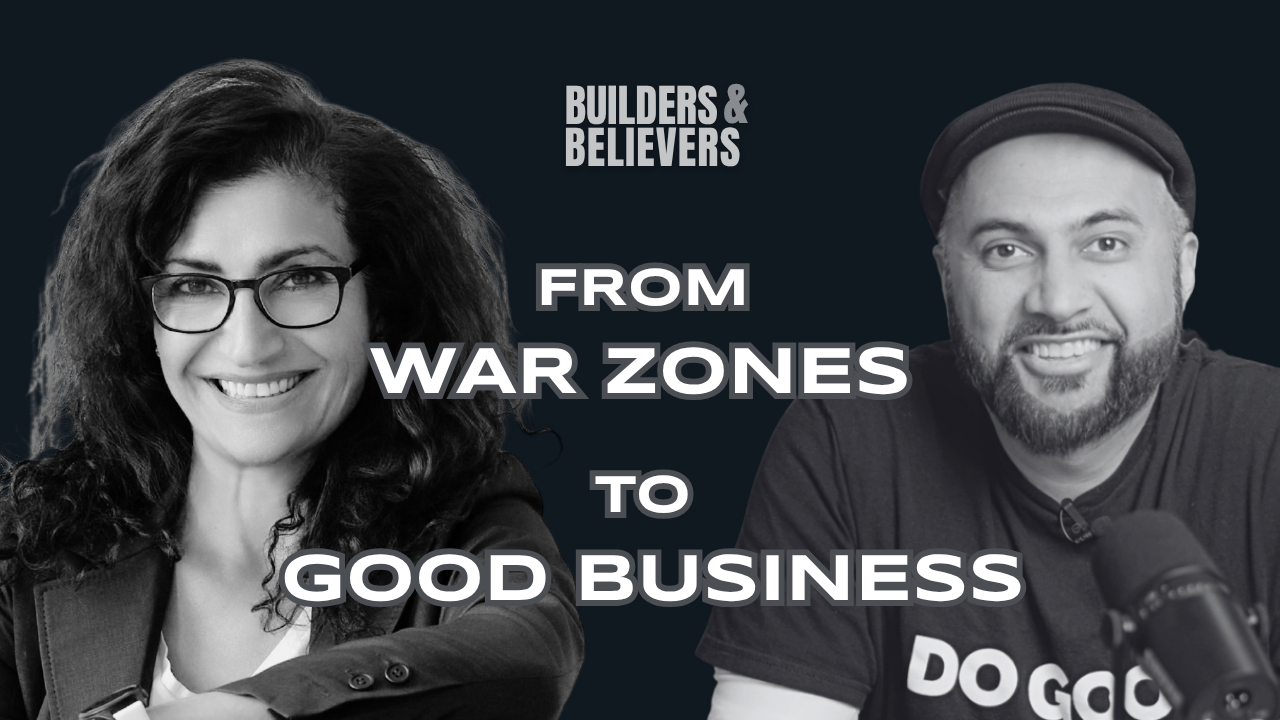

From War Zones to Good News: Building Hope in a Fear-Driven World | Muhammad Lila, Goodable
What if the content shaping you’re thinking every day is quietly shaping your leadership and your business outcomes? And what if building hope isn’t soft… but strategic?
In this episode of Builders & Believers, Amanda Stassen sits down with Muhammad Lila, former CNN war zone correspondent turned founder of Goodable. After years reporting from conflict zones, Muhammad began questioning why so much of what we consume amplifies fear.
With no clear roadmap, he started with a conviction, a simple prototype, and one idea: change the inputs, change the outcome. Today, that idea has scaled into AI-powered technology reaching millions.
In this conversation, we unpack:
How media consumption shapes mental health, and directly impacts how leaders think and decide
Why most media is skewed toward negativity, and the downstream effect on culture, behavior, and performance
How Goodable identified a missed market truth: people don’t just consume content, they’re shaped by it
Why founders stall by focusing on monetization too early, and how starting with impact creates traction and growth
How a simple prototype became proof enough to unlock a scalable business model reaching millions
This isn’t about ignoring reality or painting rose-coloured pictures, it’s about recognizing that what people see shapes how they think, how they act, and ultimately what your business becomes, and deciding whether you reinforce fear or build something stronger.
Learn more about Goodable at www.goodable.co
Follow Builders & Believers for more conversations with founders and leaders building businesses that perform and matter.
***
Builders & Believers with Amanda Stassen is created by BIZU Innovation, a strategic brand and creative partner to founders and senior leaders building growth and impact.
Follow Amanda Stassen on LinkedIn for more ideas on leadership, growth, and building businesses that perform and matter.
If this episode resonated, share it with a founder or leader who’s building something that matters.
Enjoyed this Episode?
Subscribe and share it with your friends, and don’t forget to follow us on INSTAGRAM, FACEBOOK and LINKEDIN.
Post a review and share it! If you enjoyed tuning in and learned something new, leave us a review. You can also share this with your friends and family to raise awareness about why we need sustainable food systems in a modern era.
Have any questions? Or want to share what resonated with you? Do you have any episode ideas or guest suggestions? Drop us a line at info@bizu.co
Let’s Talk. If your ready to grow your business into a profitable brand that matters, and adds value to people’s lives, let’s talk at www.bizu.co
Episode Transcription
0:00:28 Amanda Stassen: Welcome to Builders and Believers, the show about what it really takes to build a business that moves people and makes a difference. I'm Amanda Stassen, strategic growth advisor and founder of Business Innovation, where I help leaders scale with clarity, conviction and courage. Here we're going to go beyond business as usual to unpack the strategy, mindset, and leadership it takes to build companies that perform with purpose and lead with heart.
Because building something that matters takes both the builder and the believer. Today we're talking about media and mental health. I saw a stat the other day that in North America alone, an estimated 55 million people are currently struggling with anxiety and depression, with a likely millions more who have never been diagnosed. And but the question is at what cost?
According to various studies, the cost of mental health issues like anxiety and depression to North American employers and companies is huge, with estimates ranging anywhere from 200 billion to $300 billion annually due to factors like absenteeism, reduced poverty, productivity and increased health care costs. But my question is this what role does media play in all this? Like, what's the intersection between the media that we consume and mental health issues?
And can business really do anything about it? To help me dive into this. We've got Muhammad Lila, CNN, an ABC war zone correspondent turned wellness entrepreneur. He's the founder and CEO of Good Apple, one of the world's fastest growing news platforms that delivers the world's happiest and healthiest news experience. Science backed and powered by AI. Goodbye. Aim is to help you live a happier and healthier life.
And who wouldn't want that? Let's get into it. Mohammed, I am super stoked to have you on the show today. Thank you so much for being here.
0:02:24 Muhammad Lila: I'm so happy to be here. Amanda.
0:02:26 Amanda Stassen: Oh that's awesome. So now listen, I shared a little bit about your story in the intro, but just to set some context for people who don't know you and don't know your story, you take us into your story, share a little bit about it, maybe where the idea of good came from.
Take us back to what you were doing. And was there like a defining moment or an moment that inspired good people to come into being?
0:02:49 Muhammad Lila: Well, I love sharing this story, and I'll start with what I was doing. You know, some people, they have a job, they work at a factory, other people work at a clinic.
Some people sell door to door insurance. Like, my job was to cover warzones. I started as a local reporter in Toronto, covering, like, city council meetings and, like, car crashes. And I just worked my way up really quickly to becoming an international anchor and correspondent for ABC news and then CNN, where I spent many years, traveling around the world.
And, it just so happened that there were a lot of dangerous things happening at the time, and I was the one that got the call, to go out to those dangerous places. So if you think in the last ten years we're the world's biggest wars and conflicts have happened, you think of Afghanistan, Syria, Iraq, Lebanon, Gaza, Ukraine.
I've been to them all, and most of them I've been to multiple times, leading teams. And when you turn on the television and there's somebody reporting from that place saying, standing outside the place where the explosion happened, and behind me you can see the wreckage and the carnage. That was me. That was my job. And I loved every single minute of it.
To anybody that reports on television and tells you it isn't a thrill, isn't telling you the truth. There's something magical when that red light turns on, you're on, and you're delivering something that's important to millions of people around the world. You feel, some people might feel arrogant or powerful. I didn't feel that. I just felt important.
I felt like, wow, there are millions of people out there that are tuning in because they believe what I'm going to tell them. And so it's important that I do the best job possible. Right? I loved every minute about it. Yeah. And my life changed overnight. One day in Ukraine when my team and I were held at gunpoint.
Whoa. Ukraine is a very dangerous place. Much more dangerous than people think it is. And the violence that the war there's actually been going on for much longer than we think it is. Okay. And I was there when Russia was taking over the eastern part of Ukraine. I was on the ground and I saw with my own eyes.
Russian forces and paramilitary troops coming in and going literally village by village and town by town and annexing them. And one day we were caught in the middle of a crossfire. So there were Ukrainian militias and Russian militias that were shooting at each other. And we just happened to be in the middle. And I'm really calm under fire.
At this point, we actually, the situation was so dangerous that the group that confronted us actually forced us to the ground, and they had AK seven, AK 47 pointed in our foreheads while we're on the ground. And people around us were getting shot. So it was dangerous. And I wish I could say that I had this like epiphany or this moment, like you say, which is like changed my life.
I just remember thinking at that moment when my producer swears to this day, he thought we were going to die. And I just remember thinking to myself, what a funny thing this life is. And I was. I've never felt calmer in my life. It's it's strange. I just felt this sense of calm and and as though, like I was just watching this happen, like, what a funny thing.
And what changed my life was not just being held at gunpoint, but what happened right afterwards. So we negotiated our way out of the situation. I'm pretty good at talking my way out of dangerous places, and we. I talked our way out, and when I was on the flight home, I kept asking myself, why is it that they keep sending me, to, to to bad places when bad things are happening?
Right? And some people have a resume. I have a list of every airport that I've ever flown into. That's my resume. That's how I remember what I've done. And I went back and I looked at every single airport that I'd flown into. I was averaging at this point, 100 flights a year. My, my, my biggest year was 136 flights.
Wow. And I went back and I looked at every airport that I flew, flew into. And it was because of something bad that had happened. And I became obsessed with this idea of why is it that everything we see on our screens is negative all the time? And it's beyond news. It's like if you're in an elevator, if you're in a taxi, if you're in, like a shopping mall, and you see all these screens, none of that content is good for you.
It's all actually bad for your mental health. And I became obsessed with why. I kept saying, why is it like, what is it with negativity that that everybody seems to be so preoccupied with? And I didn't know it at the time, but that led me on a journey to say, listen, actually, people want to see good things. They want good news, they want good stories.
They want good people. They want good neighbors. They want good leaders. They want good everything. Why are we giving that to them? Why are we showing people all the good things that are happening in the world and only focusing on the bad instead? And that's what led me to launch quotable.
0:07:50 Amanda Stassen: Wow, wow. There's so many things that are in what you said.
It reminds me of a time, in during the pandemic. I remember when I'd be on these zoom calls. I'm sure everyone has had this experience. I'd be on these zoom calls with a client. We'd be working through some meeting and invariably we would someone would start talking about all the bad things that were happening, and it was like every meeting was blurring into the same storyline.
And it was always about we'd open up the meeting and we talk about how bad things are, what's going on in the news or what's going on in the community and how we feel. At one point. And this is where I think our conversation is just so incredible that we're having it. At one point I put a sign behind and it sort of sat on top of my head and the sign read Good News.
And so I vowed to myself, I was like, every meeting I'd open up, every meeting, I'd say, okay, listen, just give me some good news. Share any good news with. I'll never forget this. There was one guy I was in a meeting with. I'll just share this really quickly. I said share some good news with me. I need to hear some good news.
And he picked up his laptop because we're all working at home at the time, right? He picks up his laptop, he walks through his house and he turns the laptop around so I can see. And he had built a a ring for his kids and they were skating outside and I just was dude, that was so good. It made me feel so good to just share a human moment.
So let me let me ask you a question. This is a good question for the listeners to ask themselves and will viewers and anybody who does this podcast, do you believe there's more good in the world than bad?
0:09:32 Muhammad Lila: That's such a great question. I believe that there is, but we only see it if we are if we have that lens, you see what your lens is, right?
If, if you're if your lens is pessimistic, if your lenses is all about, you know, all the things that are wrong, you're going to see that much more clearly than you would the positive things. That's right. And so that's kind of how I think about it. So the the obvious question is, first of all, most people would say, yes, there's more good in the world than bad.
I, I've yet to ask a person this question and they say, no, there's more bad in the world than good. Everybody believes fundamentally that there's that. There's good things in the world and there's more good than bad. Yeah. And so the next question is, well, why don't we see that? That's why don't we see that if it look, journalism is supposed to be like a mirror that you look into and it shows you who you are.
That's the highest quality of journalism, is that you see yourself right in what's being reported. But we're in this weird, like we're in this weird timeline where that mirror is, like, distorted. You know what I grew up in? I used to go to, like, these amusement parks where they had, like, these mirrors that. Yeah, they make you look.
They distorted looking. And now it's like, that's what journalism has become. It's not showing us who we are anymore. It's showing us the distorted version of reality. Yeah. And, in order for journalism to do it, it does. It has to show who we really are. And that means the good and the bad. Yeah. Everybody's just looking at the bad.
Nobody's focusing on all the amazing good things that happen in the world. There are amazing things happening every single month. Every single day. Yeah. And if we want to see humanity for who we are, we need to look at those things. Yeah. And I think from the, from the like, you know, on the entrepreneurial side, it was a case of like, look, there's obviously a demand for this.
Nobody's doing it. So we have an advantage. It's called a first mover advantage. Why don't we just do something that shows people the good in the world? And I didn't know how to build a business plan. I didn't know a roadmap. I didn't know how to raise money. I didn't know scalability. I didn't know any of these things.
I just said, look. All I know how to do is get people to care about stuff. That's what I do on air. That's what I do as a correspondent. I'm. I mean, people know that something is important. Yeah. Why don't I just do that for good news? Why don't I just do that for positivity and show people good things and make them care?
Yeah. And it started, like, so innocently. I just went on my social media feeds and I started posting positive stories. Yeah. And it exploded. Like I went from 200,000 impressions per month to within a year, averaging 4 million. Wow. To within two years averaging 40 million. And now we're at something like 100 million per month. Like it's wow.
It's it's validating because, I set out to change the world, but I didn't know how to do it. And the world kind of said, hey, like, we could use some of this, so. So let's make this a fun journey. And I'm still on that journey today.
0:12:38 Amanda Stassen: Oh, I love that I love that. So okay, so there was an there there was an of well why why are we only seeing the bad stuff.
Why is there only negativity. So if you're, you know, looking kind of with hindsight, if I were to ask you what one word you would use to describe the purpose that drives you forward, that that you know, that personal purpose of you as a founder, as a human being that propels the work of good, a bull? What would that word be?
0:13:15 Muhammad Lila: This is the most profound a question I think I've been asked in the last several years. Oh, wow. Yeah. Let me explain why. Okay. I speak with investors almost for living. I speak with customers. I, you know, as an entrepreneur, you're speaking with people and you're building your company. Yeah. To distill all of this into one word, it's like.
Maybe hope.
0:13:39 Amanda Stassen: Oh, I love that word so much.
0:13:41 Muhammad Lila: Like, I just want to give people hope. I want and and I say this like, look, when I left CNN, I was broken. I was broken almost. I was almost broke, like, financially. But leave that aside, I was I was broken in the sense that, like all I ever dreamed of growing up was to be an international correspondent for CNN, right?
That like I grew up watching the CBC in Canada and I watched The National from the time I was probably five years old, and I saw people on television and they had funny sounding names like I did. And I thought to myself, hey, if they can have a funny sounding name on TV, maybe I could do it. Maybe I could go to all these exotic places and talk to presidents and prime ministers and and that's all that I wanted to do.
And I done it. Yeah, I did. Nominated for Emmy Awards, I, I led news coverage in front of hundreds of millions of people. And when I left CNN, I was broken. And I just thought, like, you know, I did everything that I wanted to do. What the hell am I supposed to do with the rest of my life?
Now? And, and and I just kept coming back to. I didn't want to be remembered as the person that showed people how bad the world is. I would rather be remembered as someone who showed people how good the world can be and how good people can be, and so I guess I just want to give people hope.
Again, it's, it's a small word. It's a four letter word. But it's, it's so powerful, right. That like if you give someone hope they can they can. It'll change their life. It'll it'll help them get a better job. It'll help them have a better relationship. It'll stop them from killing themselves. Yeah. If you just have if you just say to somebody, hey, you know what?
It's going to be all right. Like, we've we've I you've been there, I've been there. Everybody's been there where you're just so down. Yep. And all it takes is somebody to put their arm around you and say, hey, don't worry. Everything's going to be all right. Yeah. And, and and hopefully through football we can we can play that role.
We can tell people, look, the world is going to be all right. Yeah, yeah. Because there's still, there's still and there always has been good in the world. There is good in you. And I think that message is so powerful in a, in a time where, you know, everything seems bad and heavy and painful and, you know, wars and rumors of wars, there's just so much that is negative, that's creating so much fear that is just upping the ante on people's anxiety.
And and I mean, depression, it's just it's a message that is so powerful.
0:16:13 Amanda Stassen: The question is how do you translate that into a business.
0:16:17 Muhammad Lila: Yeah. So I take the great question.
0:16:20 Amanda Stassen: Yeah. So take me too because the vision is is it awesome? Right. Like I but take me to that day where, you know, you're bringing on your first employee or your first investor.
What was the vision that you shared that got them past the feel good? Because a lot of what entrepreneurs that I talk to you, they do want to change the world. I mean, that's who we are as entrepreneurs. A lot of people think that they get into business or entrepreneurship to make money. A lot of the time it's because you want to do something good in the world.
Yeah, that good in the world is what drives you, but it sometimes doesn't translate into the money side. So talk to me about how you balance those things.
0:17:05 Muhammad Lila: Yeah. What I had to say. So the idea for global has changed. Like we've iterated just like any other product in business. And initially, I thought we would be like, like a TV channel.
I could build like, a CNN for for good news. Yeah, yeah. And, and I started trying to, like, plan out what that would look like. And a few weeks into it, I realized that, like, to do that, we need $1 billion. It's it's not a cheap thing, right. To build a CNN. And I was really stuck in I was able to get meetings with almost every investor that I wanted to.
Because when you're coming out of CNN, they've heard of you. They they think that like, maybe you want to cover them. Every investor wants have good relationship with the media, right? There's getting meetings. And everybody every investor said the same thing. They said, come back to us when you're making money. And for any founders out there, 95% of the game is just not giving up.
Like there are so many times where I could have given up and said, you know, I'm just going to get a regular job like whatever I could do. And I said no, like I've got I've got to keep keeping to this because the world needs it. And there was one investor, an angel investor for, for those who don't know the language, an angel investor is not an institutional investor.
They're not a venture capitalist. They're not a banker. They're just a person who has money. And I met this angel investor. Her name is Samantha. I forget where we met. I think it was, through a mutual friend or something. And early on in the process, she kind of said in passing, like, hey, I'd invest in you. And so I marked her down as a yes.
But the way these things work is like, you know, you've got to get a bunch of investors together and then everybody gives you the money at the same time. It's not just like, yeah, I'll give you some money. It has to be organized. So I. Marketer's a yes, but I kind of forgot about her. And I remember probably it was one of the lowest moments of my life.
I didn't know where my next mortgage payment was going to come from. And, I was really down, and I just had this this intuition. And I picked up my phone, and I, I know investors were saying yes at the time, and I texted Samantha and I said, hey, Sam, would you be comfortable being the first money in?
And she texted me right away and she said I'd be honored. Wow. And I, we agreed on terms very quickly, like over text message and within, I think 48 hours. She had wired me the money. Wow. And it wasn't a huge amount. It was it was a $10,000 investment, which is incredibly small by today's standards. By the way, this.
But that $10,000 taught me two things. Number one, it showed me that people are willing to invest in this, and it was just this mental barrier that I had crossed because I said, no, now I know I'm doing something of value because someone believes in me. Yeah. And we actually took that money. We built a small prototype, and I put that prototype on my phone.
And when I would go to meetings, instead of trying to convince people about a vision, I would just hand them my phone, you know, to hear here, play around with this. Yeah. You let me know what you think. And as soon as they saw that on the phone, they realized, hey, this is like a real thing. This isn't just a pie in the sky idea.
It's an actual product. And, we wound up raising millions of dollars. Thanks to that one $10,000 check that we got from somebody who believes in us. And, Samantha and I still stay in touch today. We're still, you know, the great founder investor relationship. I messaged her, when I have problems, she helps me solve them. And, that's that was the that was the, the catalyst that started this whole journey.
0:20:41 Amanda Stassen: Wow. And so when you were, when you were sharing the vision with Samantha, you described it as how did you describe it? So that she could see where the money was going to come from?
0:20:54 Muhammad Lila: Yeah. So at the time, we just described it as a news network that only covers good news. And that's what we built as that's what we launched as.
And what we found was actually, we had built AI before people were even talking about AI. So we built AI to power our app. Okay. And we thought a good news app was something people would pay for. And they do. And and the product that we have is incredible. It's clinically proven to reduce your anxiety and depression.
There are people who are alive today. I no exaggeration, there are people who are alive today because of the content on our app. And we know because they've told us, we thought it would scale very quickly. When you build consumer mobile products, it takes a long time to scale. And what ended up happening was, organizations started reaching out to us, like the CEO of Yahoo reached out to me, very senior people at very big social media platforms reached out to me and I didn't know who they were.
And in at least one case, they DM'd me on social media. Like who DMs people like when you're the CEO of, like Yahoo or Pinterest or something, but they did, and they basically said, we really like what you're doing. Can we integrate your AI into our platforms? And so we started as a good news network that got a lot of investors on board.
And what we realized was that the technology that we built to power our product was actually more valuable. Than what we thought the product was. And so now we sell our AI directly to, to users and customers. And so we took something that was limited, like our app was, was it's an app. Like to experience it, you've got to download the app.
If you use Calm or Headspace to experience them, you have to use the app. What we did is we built a high that can put positive and wholesome content onto any screen in the world, not just an app. We could be on social, we could be on search engines. You'll be in social media feeds. In fact, we are partnerships.
We're in something like 35,000 screens across North America. Wow. We're in the Empire State Building, 30 Rockefeller Center, the Willis Tower in Chicago, the TD Bank towers. We're on a bunch of them. And and it was because of the technology. So we thought, I genuinely thought we would build CNN for good news. What ended up happening was rebuild technology that's actually bigger than that, that that allows us to control any screen, not just, not just our app.
So the vision really change. But to directly answer your question, we started building a news platform that only covers good news, and we've just grown and grown since then.
0:23:40 Amanda Stassen: Well, I think the application is so broad. I mean, the fact that you're selling you're selling the technology into other platforms is remarkable. I want to zoom in a little bit on the intersection between media consumption today and mental health.
You know, I think that there's a lot I'm sure that you can talk about that. But I want to I want to kind of dive into two things, because there's there's, you know, that media is sensationalizing negativity. And is that to blame for kind of the skyrocketing levels of anxiety and depression. So that's kind of one piece. But then the second piece, which I'm really curious about, is by showing people only the good stuff, are we painting a Pollyanna world and I'm, I'm playing that the negative side.
I don't actually believe this, but I want to hear I want to hear your perspective because I get that a lot. It's like, yes, we can talk about the positive things, but the fact of the matter is, this is the real stuff that's happening in the world today, and people need to know the real stuff. I'd love your take as a journalist, but also now that you're in the wellness space, what's your what's your how do you feel about that?
0:24:50 Muhammad Lila: So let me let me deal with the first part of that question first. There's a direct correlation between the amount of time we spend looking at screens and the state of our mental health. The data is overwhelming. And in fact, it gets even worse the younger that you get. So trusting. So what they found was, you know, rates of depression 30 years ago for teenagers were much lower than they are today.
Okay. And when they looked at all the causal factors, the biggest one is the amount of time people spend looking at screens. And you can take it a step further and say, okay, well, what do we see on screens? Well, everything comes from algorithms. So whatever social platform you're on, whatever like Instagram or Snapchat, whatever that is, you're actually not choosing what to see.
We might think we're choosing what to see, but it's actually an algorithm that feeds it to us. The problem is that those algorithms are 95% bad for your mental health. So it's not that there's nothing good on those platforms, it's that 95% of it is actually bad for your health. And so there's a direct correlation between media consumption and the state of your mental health.
And the biggest proof of this is, in the United States, unfortunately, there are mass shootings probably once a week. And sometimes if you look at one of these mass shootings, in those rare cases where the shooter is still alive, the first question they're asked is, why did you do it? And the answer they always give is, oh, I saw something on the news, or I saw something on a social media platform that made me believe that those people were bad.
Right? And so I killed them. So it's it's actually so bad that it creates depression and paranoia and mental illness on such a large scale that someone will pick up a gun and shoot somebody else because of what they've seen. Now we've built algorithms that instead of feeding you negativity can feed you positivity. And this goes to your second question.
Aren't we just painting like, a rosy picture of the world? That's not true. And the answer is no. And the reason why is, if you think of all the different, media verticals, if you call it that. So, you know, there's, like, regular news, like, I don't know, New York Times, BBC, whatever. And then there's like financial news.
So there's Wall Street Journal, there's Bloomberg, there's CNBC, and then there's sports, ESPN and TNT and you know, all those networks, there's verticals for everything. Why should there be a vertical for positive things happening in the world? Like we're not aware of one. Right. And so what we're saying is look, we're not out to replace CNN. We couldn't even if we wanted to, because CNN is so addictive that we couldn't break that hold.
What we say is, look, I use this analogy. Most people, when it comes to their media diet, it's a very unhealthy breakfast. So you're having like, your greasy bacon and your eggs and your fried this and whatever. Like it's probably not very healthy. Just add us as the healthy smoothie that you have as part of your breakfast.
Nice. It's going to change your whole diet, but just give yourself enough of that. Those nutrients, to have some sort of positive effect on your mental health. And that's what we do. Nice. We're trying to position ourselves as like the whole foods of media consumption. Nice. And we don't have to replace anybody else. We just need to make sure people come back to us for five minutes a day and we will improve their mental health.
0:28:20 Amanda Stassen: Yeah, yeah. And you guys have done clinical tests now.
0:28:23 Muhammad Lila: Yeah. It was very interesting because yeah, you know, we had this hypothesis that said, hey, if you replace the negativity and you replace it with something positive, it's going to positively affect your mental health. So we had to run clinical trials to prove it. And what we found was that, on single exposure, we were improving mood by up to 96%, which means like, you're in a bad mood, you're looking you're in a subway platform, you see something positive, it puts you in a good mood.
Nice. That's single usage. When those numbers were higher than we thought, we said, let's try this over a longitudinal period. So calm and headspace, they both test themselves over like a two week period. And we said, let's set up something similar where we test ourselves over similar period. And what we found was that if you consume giftable for something like, three minutes a day, we can we can reduce your symptoms of anxiety and depression by 25%.
Wow. And what's amazing about that is to us, it's like people are shocked at that, but like, it. To me, it's the most obvious thing in the world, right? If you're hooked up to an IV drip and what's in that IV drip is bad for you, instead of trying to plug in something else to counter that effect, why don't you just change what's in that IV drip?
So take out the poison and put something good for you. Well, what happened to your body? If you did that? Well, your body would be cured, right? And that's what we're doing with content. We're just your people.
0:29:50 Amanda Stassen: Right. And it's it's content. The the piece that is so wonderful about what you're talking about is you're reporting things that are happening.
These are not made up moments of positivity. These are actual things that are happening around the world by regular people, by people all over the world. These moments, these glimmers of hope. So it's interesting because for a lot of people, even in business and entrepreneurs, there's still a lot of people that are on the fence regarding AI and the notion of AI for good.
You guys have found a way to really move AI as a tool for gathering, for researching, talk about how you how you are navigating this world of AI for good.
0:30:33 Muhammad Lila: So, you know, if you're in a newsroom, typically there's a meeting at 10 a.m. every morning where a bunch of reporters or journalists sit around a table and they say, what are we going to cover today?
Yeah. And then you get your marching orders and you go and you cover it, and then by 6 p.m. or 4 p.m., your story is supposed to be done. And like, that's what's in the newspaper. That's what's on the website. We automated that entire process through AI, and we knew we could because the technology existed. That allowed us to.
So instead of saying, hey, what are we going to cover today? We've trained our AI to actually scan every single news feed in the world, and content feed and blog and like, you know, social media channel, we bring in all this data and we've trained our AI to tell us whether, what's on those content feeds is positive or negative.
It's actually a very advanced application of AI, and we built it ourselves. It's not like ChatGPT where we're just pouring it. We tried all the off the shelf models and none of them worked. None of them can accurately predict whether something's positive or negative. Interesting. So we trained our model over several months and years to the point now where it's 99% accurate.
Which is fantastic. Like if you know about AI, it's easy to get to like 90% accuracy. Yeah. Going from 90 to 98 is really hard and 9200 is almost impossible. Yeah, yeah. We're at 99. And we've trained our AI to apply not just to content feeds, but soon it can apply to anything. So Amanda, if you were to send me an email or a text, I could actually run that through our AI and it would tell us is this positive or negative?
And it gives us a score out of 100 and so if you use the ol app, for example, every story has what we call a happiness score attached to it. So you will tell you this story is 98.5% happy. This story is 70% happy. And so it's like kind of a classification system.
0:32:30 Amanda Stassen: Yep. Almost like like a nutritional label.
0:32:33 Muhammad Lila: Yep. Right. Like here's how much sugar this has. Here's like how much saturated fat? Well ours is well, here's how positive this story is. Yeah. And it takes away some of that guesswork because it's, what we do is not just our opinion. It's actually backed by science.
0:32:51 Amanda Stassen: Yeah, yeah. And and it's, because there's this murky ground, you know, this whole space of can I reason and does it have a moral compass?
And I think what you guys are, are moving into or starting or have moved into is this place of, we're going to teach AI to judge things from the lens that we're we're putting out there because you've created the criteria, and that's what I is you using as the go forward. How much adjustment do you guys have to do?
Like are there times where it comes back with some things that you have to say, okay, we're going to reteach you this again because you didn't quite get it.
0:33:28 Muhammad Lila: Yeah it's a good question. We the way we've built our model is that it's it sort of retrains itself. I can't get into too many details about that, but I can, I can the bigger picture is interesting because what's good for me may not be what's good for you.
Right. What's good for you may not be good for somebody else. Current around the world. The best example of this is what's happening in America right now. So America is like almost split right down the middle. All of the last elections, they've had been like very close, right? Like 51, 52%. It's been so close. And, you know, I'll give you an example.
Yeah. The United States talking about, annexing Greenland. Right. So for half of America, that's the best thing that could ever happen. But for the other half of America, that's going to start World War three, like it's split. So down the middle and it becomes very difficult to say what's good and what's not. When we started looking at this, we had to we had to avoid our own opinions.
Yeah. Because our team is diverse. What's good to Canadian may not be what's good to an American. What's not I mean, France and what we found actually was that if you think of the entire spectrum, there's 10% on either side that are just the extreme, and they'll never agree on what's good. Right? You could show them the most positive thing in the world.
Like you could say, hey, cancer was just cured. Is that good? Those 10% on either side will say, well, was it a Democrat or a Republican that that cured cancer? Because if it was one of them, then that's not good. So we removed the extremes. And what we found was that there's 80% in the middle where almost everyone will agree, where something is good.
So here's an example. But scientists discover a new way to treat breast cancer with 100%, effectiveness. 80% of people will say, this is amazing. A firefighter jumps into a frozen lake to rescue a dog that was drowning. Everyone will say, that's amazing when we ignore the extremes, what you find is that in the middle, that's where people come together, right?
And that was unintentionally. We found that we started bringing people together because people with different opinions could all agree that, yes, this is good. Yes. And that's how we trained our AI to not worry about extremes. So if you're on the app or you see good content on a screen, we'll never touch anything contentious. Abortion, immigration, wars, conflict, there's a whole bunch of things that are just contentious.
We'll never talk about them, right? Because we're not ones to judge. Right? Like, I can't judge whether, you know, some new law that was passed as good or bad, but I will focus on or those things that everybody says is good and there's more than enough there, to achieve our goal of making people.
0:36:30 Amanda Stassen: Right. Oh, it's so good.
I saw one, little clip. I think it was, veterinary doctors, who were dancing with a parrot. What was so remarkable with that little clip? And I really appreciated seeing it. It it was so it was just joyful. Yeah, it was just joyful. Right? It's just a human moment. Don't you feel like all of us just need more of those moments?
0:37:00 Muhammad Lila: Yes, yes. Like no politics, no stress. Just those little moments of, like, pure joy. Yes, yes. It's like you remember when you were a kid and you blew out the candles on a birthday cake you weren't thinking about, like, anything else? It was just joy. Yeah, right. Maybe your family was there. Like, it was just that. That innocent joy.
And I just feel like the world needs more of that.
0:37:25 Amanda Stassen: Oh, absolutely. Absolutely. You know, the thesis of this show is to prove that business can do real good in the world, and be successful. So its purpose and profit. So be successful and profitable. What's your philosophy for business? What's your take on it?
0:37:42 Muhammad Lila: So I tell investors all the time that we're going to be $1 billion company.
But we're going to do it by helping a billion people live happier and healthier lives. And I don't think they're mutually exclusive. There are some companies and some models out there that they are exclusive. Where you can't make the world better and still turn a profit. Like I don't know, companies that deal with like repossessing loans and forfeitures.
Right. Like I get it right. There's, it's a zero sum game. There's a winner and there's a loser. I just think that, you can do it together. You're winning. Doesn't have to come at the expense of somebody else. When I was in grade seven, I was in a new school, and it was much bigger.
And I didn't have a lot of friends. And my grade seven music teacher, Mr. Albert, taught me one of the greatest lessons I'd ever been taught. Okay. And he said. He said, Muhammad, if if you want to be popular, just help as many people as you can because everybody loves the person who helps them. You're not a threat.
You're a friend. They see you as sincere and you did something for them and just just help. You said, just help people. And before you know it, you're going to be the most popular kid in school. And I took that lesson and I applied it to goodwill. And I said in the beginning, I said, look, team, let's not even worry about money.
Let's not worry about monetization. Let's not worry about customers or ideal customer personas. Let's just help people, just help people and see what happens. And I think it was the best business decision that we'd ever made because we started helping people. And then they told their friends and they told their boss, and then they told their board directors.
And before we knew it, we had CEOs of major corporations reaching out to us to saying, hey, we want to work with you. And it's it's because we just started helping people first. And I think there's a pathway there. There's a template there for other companies to focus on helping people, as a business decision. And, and if you do that and if you do it with sincerity, only good things will happen.
0:39:54 Amanda Stassen: Oh, that is such. That is such a great message. And it actually bleeds into, you know, as we come to the close of this, episode, I like to ask, what are some practical tips? What are two practical tips that you would share that would help founders and entrepreneurs purposefully accelerate their business and brand growth today? And I think you shared one of them.
So give me another one.
0:40:20 Muhammad Lila: Yeah. You know what?
It's advice that I didn't take. I was a little bit more, cautious and nervous and insecure. I would say just start time. Like, just start if you have a dream, if you have a vision, just start. Like, you know, I was always the kid that would never do these big cannonball jumps into the swimming pool, right? Like, I would, I would, I would go in, but I'd take the stairs oddly walking and dip your toe and let's be honest, like it's cold, right?
So, like, you know, like, I was always cautious. I'd always make it into the swimming pool. And I enjoy swimming, but I never dove in. And I think the important thing is just just get in the water. Right. You'll you're going to start learning right away and you're going to make mistakes. In if you're a founder, you're going to make so many mistakes.
It's better to make those mistakes early. And what that means is start early so you can start making mistakes and learn from them and then not make those mistakes again. If you delay it too much, you're actually losing out on so much valuable experience that you can get. And so my advice would be just start like if you if you have a vision, if you have a dream, if you want to build a company like just start and maybe it will work.
But even if it doesn't, what you've learned is only going to help you be a better person and a better founder moving forward.
0:41:44 Amanda Stassen: Yeah, that's so true. It's so true. And it's something I hear all the time because there's so many. It's you know what? It's it's it's our brains have been hard wired. Maybe it's for survival, but we see the pessimism and we see the negativity, you know, which is what we've been talking about.
So it prevents us from starting. It's like the what ifs are always negative. What if I fail? What if they don't like it? Right. So the advice of just starting is so powerful. It's so simple, but it's so powerful.
0:42:11 Muhammad Lila: Yeah. It's like, you know, if you're if you're like, you know, in grade school and there's like a senior dance or something and you're thinking like, I don't want to go because nobody's going to like me or I'm not going to friends.
They're like, what if I ask her and she says, no, but like, and that's fine. And sometimes that's debilitating. Yes. For a lot of us, like especially if you're an introvert like I am, you always think about, well, what could happen if it goes wrong. You know what? Like what if they're going to turn me down? What if they're going to say no?
What if it rains? What if there's a fire like you think of all these things. Yeah, but a different way to phrase it is like, well, okay, all of those things could happen. But what happens if it goes right? Right. And if you think about if you say, look, there's a chance that it could go right, then go for it.
What's the worst that's going to happen? You're going to be the same off today as you were yesterday. Yes. The best that can happen. Yeah. Just have a life changing experience. Yes. That turns you into a different person. And so I think you just just do it, you know, like, just work up that courage to say, hey, you know what?
I'm going to do it. If it doesn't work, that's fine. But I got to try.
0:43:18 Amanda Stassen: I love it, I love it. So where can people connect with you and learn more about Good Abul, share some of your, your URLs or connection points.
0:43:27 Muhammad Lila: So the first thing is, I would highly encourage people to download the app. It's called goodwill, the happiness app.
It's available on iOS and Android. It has, 4.9 star ratings, tens of thousands of downloads. People use it every day, download the app and try it and see what happens. If you allow yourself that joy of seeing positive things every day, it doesn't take long. Give yourself a minute or two every day to just kind of check the app.
The way you check Facebook, your messages, just check the app, download it on the App Store. And then we exist on social media. So you'll find us on Instagram, Facebook, Twitter, although we're not on Twitter or like as much as we used to be, for other reasons. But find us on social media and then our is just good.
Balko. So if you're, what we're experimenting with now is we're not experimenting, but what we're expanding to now is a lot of enterprise activations. So if you run a brand or you're part of an organization that wants to have happier and more positive workforce, reach out to me, because that's exactly what we specialize in.
0:44:35 Amanda Stassen: Nice. Nice. Muhammad, thank you so much for sharing your experience and your insights. And just in case you haven't heard it today, thank you for living and sharing your purpose. And thank you for sharing good news. The world is made better because of it. Thank you so much.
0:44:51 Muhammad Lila: Oh thank you, thank you. I hope people are watching the video because you're making me blush.
But, thank you, thank you. This means so much that you have, such nice things to say.
0:45:02 Amanda Stassen: Appreciate you. Thank you. Thanks for listening to Builders and Believers with Amanda Sasson. If today's conversation gave you something to think about or reminded you, why you build what you do, share it with a founder, leader or team who's on the same journey.
You can follow the show wherever you listen to podcasts and join me on LinkedIn or Instagram for more ideas on leading, scaling, and building businesses that move people and make a difference. If you've enjoyed this episode, please take a moment to rate, review and share it with your network. So together we can spread the message of building business as a force for good.
Because building something that matters takes both the builder and the believer. Bye for now.
Listen, watch, & subscribe
Want to elevate your business game & stay ahead of the competition? Tune in to learn how to grow your customer base, build a thriving employee culture, attract investors AND create positive impact.


