
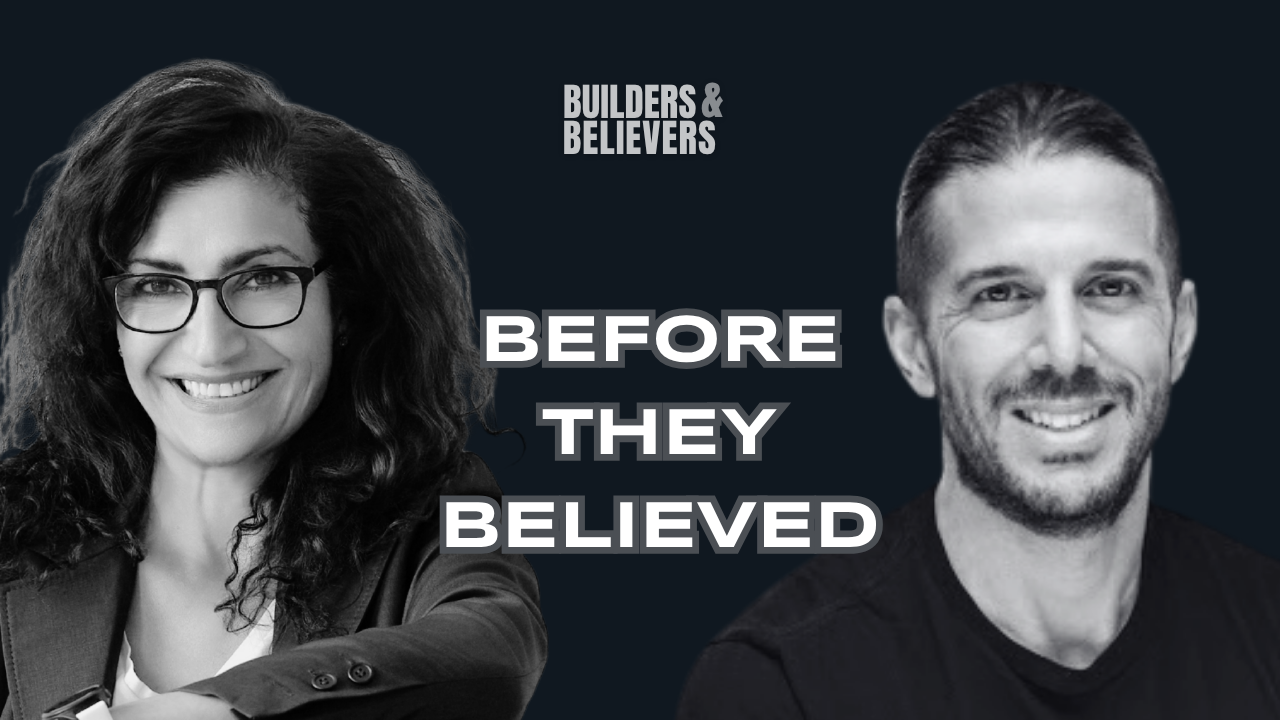

When You're Early: How Personal Conviction Becomes Commercial Opportunity | Co-founder of Manitoba Harvest
When do you trust your conviction, and when do you question it?
Every founder eventually faces the same dilemma: Is this an idea the market simply hasn't caught up to yet, or is it time to let it go?
In this episode of Builders & Believers, Amanda Stassen sits down with Mike Fata, co-founder of Manitoba Harvest, to explore how a personal health journey became a company that helped redefine an entire food category.
Long before healthy fats became mainstream, Mike believed the market was headed in a different direction. That conviction led him to build Manitoba Harvest into one of the world's leading hemp food companies before its acquisition in 2019.
Together, Amanda and Mike explore what it takes to turn personal conviction into commercial opportunity, including:
Knowing when to trust your vision, even when others don't see it yet
Why the best market research still happens through conversations with customers
The risks of growing too quickly and the lessons learned from getting it wrong
Building a personal brand alongside your business
Why purpose and profit work best together, not in opposition
The B!G Idea
Every founder reaches a moment when conviction is tested before results appear. Mike's story is a reminder that building something meaningful isn't just about seeing opportunities. It's about having the courage to stay with them long enough for others to see them too.
Learn more about Mike Fata at www.mikefata.ca
Connect with Mike on LinkedIn and Instagram
Resources Mentioned in This Episode
Grow: 12 Unconventional Lessons for Becoming an Unstoppable Entrepreneur by Mike Fata (available at Amazon)
Manitoba Harvest www.manitobaharvest.ca
***
Builders & Believers explores the thinking, decisions, and beliefs behind building enduring businesses, organizations, and ideas.
Powered by BIZU Innovation, where the same thinking behind these conversations helps organizations clarify strategy, strengthen brands, and build ideas that perform and matter.
Follow Amanda Stassen on LinkedIn for more conversations on leadership, innovation, and growth, or learn more about working with BIZU at bizu.co.
If this conversation challenged your thinking, subscribe, leave a review, and share it with a founder, leader, or team building something that matters.
Because building something that matters takes both the builder and the believer.
Episode Transcription
0:00:00 Amanda Stassen: Not all founders get it right when you have a gut feel. I just saw like, the world's gonna change. 25 years later now, it's all about good fat. On the media is talking about that. Government's are trying to work that out now because they were wrong about it. It took a long time, but it was just seeing the vision earlier that other people saw it. And I became super excited about that. I wanted to tell people, hey, I thought fat was bad too. And then I learned about healthy fats and now we're offering one.
But you should eat all these other, you know, like olives and olive oil and all these other healthy fats. And I can do that all day long. Oh, yeah. Didn't even feel like job for me when I was just starting. I wanted to share that message.
0:00:45 Amanda Stassen: of how brands show, where we have conversations with leaders and brands transforming business into a force for good. I'm Amanda Stassen, business and brand strategist, entrepreneur, and founder of BIZU Innovation. I'm speaking with business visionaries and game changers, corporate leaders and entrepreneurs, the dreamers and the doers, who are proving that not only does purpose drive profit, but the future of our world depends on it. Two questions I get asked a lot is, what's the difference between passion and purpose?
And how do I take my passion and turn it into something more, maybe even a business? You passion's a funny thing because it's what gets us excited. It's what fuels and energizes us, but it's a very inward focus. It's very self-focused. It's what makes me happy. It's what energizes me. And as we know, anything that's just about me can start feeling a little bit aimless.
Purpose on the other hand is what gives you direction. And it's actually what turns that passion that you have from what's just good for me into what's good for others and maybe even good for the world. It's what turns that what's happy, what makes me happy into what makes others happy. And that combination of passion and purpose is a fire. The most successful entrepreneurs and leaders have both passion.
They have fashion that fuels their tank and motivates and energizes them and they have purpose that guides and propels them forward towards their direction. The question is how? How do you do that? And then how do you take that passion, maybe that personal quest that you have to do something for yourself and turn that into a business? Now I'm really excited because to help us explore this, we've got Mike Fata.
co-founder of Manitoba Harvest Hemp Foods, a Canadian global leading manufacturer and brand of hemp food products that sold in 2019 for $419 million. It's a massive exit. Today, he's the CEO of Fata & Associates, investing and advising a portfolio of companies that a lot of us know, including Midday Squares and Bloom. He's also the author of Grow.
12 unconventional lessons for becoming an unstoppable entrepreneur. Let's get into his story. Mike, thank you so much for joining me today. I am super stoked to get into your story and get into how you built Manitoba Harvest Hemp Foods into a $100 million business that you then successfully exited for over nine figures. This is a story I've been waiting to dive into. So thank you so much for joining.
0:03:29 Mike Fata: Yeah, thanks for having me.
0:03:31 Amanda Stassen: Awesome. So let's start at the beginning. Let's start at the beginning, set some context for everyone who may not know you, share a little bit about your background growing up and what eventually led to perhaps an aha moment that got you starting or thinking about Manitoba Harvest.
0:03:50 Mike Fata: Yeah, well, I'm a Canadian.
born in Thunder Bay, Ontario, but grew up in Manitoba.
0:03:56 Amanda Stassen: I didn't know that. Okay.
0:03:58 Mike Fata: Yeah, I grew up pretty poor with a single mom, you And that was one of the deciding factors for me leaving school. So I dropped out of high school and started to work. And unfortunately, I prey to fast food. ate way too much McDonald's and Burger King and other fast food, processed food, and found myself at three and a
300 pounds at 18 years old. we just, that was my rock bottom moment. And sick and tired all the time. And then one day decided to do something about it, which led me on a health journey, which got me super interested in hemp seeds and the nutrition of hemp foods. And we started Man to Harvest. And that was 1998.
0:04:46 Amanda Stassen: Wow. Wow. It's been quite a journey. Like if you look at that timeframe and
It's so easy to go back. We've got like 20, 20 vision and, but I want you to kind of tap into that 20, 20 vision. And if you could just distill that into one word that you would use to describe, you know, your purpose, the thing that compels you forward, what would that word be?
0:05:14 Mike Fata: Growth. think, I went through that period in my life that I felt like everything was out of control for me.
And I was like spiraling down even. And then when I took control of my health and I lost a hundred pounds and I got interested in like, and, you know, really understanding that I could control my physical body. And I got into business and started that growth cycle in business. I became super, super passionate. And 28 years later, I'm still just as passionate about personal and professional growth. wow.
0:05:46 Amanda Stassen: You know, I love that you said passion. I love that you said the passion because to me, passion is kind of that personal fire, that personal enthusiasm, that thing that gets you super excited. Passion is like, you know, and it sounds like you were trying to solve a problem for yourself. You want to get healthy and that became your passion. How important is passion in entrepreneurship?
0:06:09 Mike Fata: I mean, some people hate that term. I talk about all the time and say, any
Any person that's telling you that follow your passions like a guru and you know, and they and and you know, don't take them seriously. And you said it there yourself when you're describing it. But if people have a hard time with the word passion, I would say excited. What are you excited about? What excites you? And that doesn't mean that you can't.
you know, get a job and become interested in or excited about something. But if you really follow your heart, like what you want to do in life and what you're truly excited about, and then you go after that, I just find that those type of people, you know, those entrepreneurs, even the that are not entrepreneurs that are in business, like just want to out compete. They want to learn more because they're excited about whatever it is and they want to practice more and they become successful.
because of their excitement or because of their passion?
0:07:09 Amanda Stassen: Yeah, yeah. I actually have a theory. My theory is that passion is an inward expression. It's an excitement fuels and it's like, you you get so excited to do, but it's for you. It's personal to you. Purpose, purpose transforms that passion from an inward thing to an external thing. And that's when I think like the most amazing entrepreneurs, the most amazing leaders have a combination of both.
because they go from taking that sort of what, like your quest, for example, which was, wanna get healthy, at some point, it transformed from a personal passion for you to get personally healthy into a, wanna help others. Like that pivot happened and that became your purpose. Talk about that a little bit.
0:07:50 Mike Fata: Yeah, I think that helping others, I've always wanted to help others. think it's the most...
selfish, selfless thing that I do. I do it because it makes me feel good. I do it because my mom set a good example on me of helping others even when she didn't have a lot herself. And so, you know, it makes me feel good to do that. And then, you know, in return, the world like, you know, even if you don't want something in return, you're going to get something if you're helping other people. I've realized that over the last, you know, 20, 25 years of just helping.
being a servant-based leader and helping my team grow and understand them and what's the next step of them, helping our customers and our consumers get healthier by introducing a health food product and educating them about healthy lifestyle. All these things that I'm doing because they fire me up, they literally light me up. But the benefit is also double because not only does it light me up, but I get all the benefit of helping all these other people.
could be monetarily or just could be good vibes, good karma.
0:08:51 Amanda Stassen: Yeah, yeah, yeah. So let's go back to those early days. You had this epiphany, you had this idea. Did you see a gap in the market? Because at some point, a business is about solving a problem.
0:09:03 Mike Fata: Yeah, yeah. As part of my weight loss journey, I went on a no fat diet, which was pretty popular in the mid 1990s.
I kind of got duped like on one of these fad diets. like, if you cut out all the fat, you'll lose weight. And I was like, okay, no fat, no fat. Okay. then, and like I do in life in general, I jumped all in and, and, then I learned the hard way about what we know nowadays, like essential fatty acids, right? Like you need good, healthy fats. It just needs to be the right type of fat. So when I learned that a couple of years into my weight loss and I discovered that hemp was the hemp seed.
contained omega-3 and contained these essential fatty acids, these essential fats that we need. Then I went from the no fat diet to like, oh, things are going to change more to the right fat diet. that became my vision. became the message that I wanted to spread with other people.
0:09:57 Amanda Stassen: I like that from the no fat to the right fat and it's sure beats fish oil. I'm not going to lie. Like, it's a better.
0:10:04 Mike Fata: And you know, that doesn't always come right, you know, I
Like not all founders get it right. When you have the gut feel. just, I just saw like, the world's going to change 25 years later. Now it's all about good fat. Like in every, on the media is talking about that government to kind of work that out now. And because they were wrong about it, you know, it took a long time, but, it was just, it was just seeing the vision earlier than other people saw it. And, and, and I became super excited about that. wanted to tell people, Hey, I thought that was bad too. And then I learned about healthy fats and now we're offering one.
But you should eat all these other, know, like olives and olive oil and all these other healthy fats. And I could do that all day long. Oh, yeah. I didn't even feel like job for me when I was just starting out. I just to share that message.
0:10:54 Amanda Stassen: Yeah, yeah, yeah. And did you do any validation? Like, did you in those early days? I mean, 1998, it wasn't really the topic du jour. So how did you how did you validate the idea?
0:11:05 Mike Fata: Yeah, validation for us was just talking to our customers. So we did a lot of demos, which then in stores, which then turned into consumer shows like going out where a health festival or somewhere, you know, a natural food show somewhere on the weekend where consumers are getting together, learning about new things and we pitched to them.
I tell entrepreneurs the best thing you can do is stand in front of your customers over and over again, trying your pitch lines and then listening to what they say back to you because that's the ultimate validation. You can't get better consumer research than doing it yourself and talking to a thousand people over a weekend. You're going to learn a lot. so I credit that to our success. over time, we just continue to grow that as we grew the business. we did.
health shows and consumer events like that every single weekend across cities across Canada and the US.
0:11:53 Amanda Stassen: Yeah. Yeah. And it's not something like I love. I talk to a lot of entrepreneurs. I'm an entrepreneur. We're constantly in the world of building products. there's this almost reaction that some entrepreneurs have where it's like, want to offload that to somebody else.
And I keep saying, well, guys, you kind of need to hear it yourself. You need to hear it. As the founder, you need to hear what customers are saying. can't, yeah, sure, a distributor could tell it. Maybe a broker could tell you. But like you yourself hearing that is gold because that's where the insights are. Like what was your experience in that? Was there like a rush to get into a distributor?
0:12:34 Mike Fata: No, I, well, you know, we, yes, we, we, we expanded distribution and went into more stores, but I always listened to customers.
One that lit me up because I was going on my health journey. wanted to connect with other people on their health journey. So it did fire me up personally, but I learned in business, you can't go wrong when you listen to your customer. I share stories that until we were easily a $10 million a year business, which took 10 years for us to get to $10 million in annual revenue, I would take turns on the customer service line at the office. would answer the 1-800 number and talk to people that phoned in and they were like,
complaining about the seal on a bag of hemp hearts or how our shipping was a couple of days late or whatever they're confused about or the question that they had. hearing that personally fired me up and fueled me to take that into business and then turn that into how do we change our approach to make it more pleasant on our customers? we didn't need to do that until we became ultimately world-class.
0:13:42 Amanda Stassen: Yeah, that's so good. I want to dive a little bit into the health and wellness category, the natural product category, obviously since 1998. It's grown massively over the last decade. More and more entrepreneurs are getting into it. There's a lot more founders. There's a lot more new products. Shelf space is super competitive and it's getting harder and harder to break through.
What are you seeing? Like, what are you seeing in terms of white space opportunity for entrepreneurs who want to break into this space? Is it more about like, extensions of like really bad for you products that are now just becoming better for you? So like the better for you sodas, I'm thinking, you know, a poppy and some of the lines that are that are really successful now. But like, what's the white space that you're seeing?
0:14:29 Mike Fata: Yeah, I mean, I think I think we're going back to how it was before. Okay. And so
When I started in the business in 1998, the natural and organic product category was about 5 % of all food sales. So 95 % of foods were like ultra processed foods and just general foods. 5 % were new natural and organic products. Yeah. Over the last two and a half decades, that's about just over doubled. So it's just over 10 % of the food is like health food, natural food, organic food. 90 % of it is still more, um,
you know, ultra processed food and processed foods, branded products in the, in the, in the kind of center of the store. I think we're going back. What, what the, what I see in consumers in the marketplace is people want, simple ingredient products. want whole food products. They want to have products that they could pick up the label and, and it reads like they would read it, like they would make it in their kitchen, which again can still be a, can still be a processed product.
but not an ultra-processed product. We're gonna continue to see the cleaning up of each one of these categories in all aspects of the store. it takes the, these big food companies aren't going to do it. They're trying to hold their own by their legacy products that a lot of them aren't so good for us. It's the entrepreneurs that can bring innovation and bring their own excitement to the category and create these new things.
And again, I've seen it like, now we're reinventing pop tarts and, and, uh, and, and everything in the baking aisle and yeah, soda is better for you, lower sugar functional. So like every single category, I believe in every aspect of the store is going to continue to be reinvented until ultimately we get back to more of a sustainable food system and like a healthier food system at least 50, 50. It doesn't make any sense still at 90 % kind of.
process, ultra processed to 10 % natural organic.
0:16:28 Amanda Stassen: And would you say, I want to kind of put out a provocation, would you say that it's the convenience that consumers are buying? Because you've said it yourself, like these ingredients are going to be so simple. A lot of them are so simple that you could do it in your kitchen. So why aren't they? it the convenience that is the factor that we're paying more for these healthier products?
0:16:53 Mike Fata: Yeah, for sure. I think, there's,
Paying more is a little bit of a tricky thing. The more is because the scale's not there, right? And unfortunately, we based a lot of the industry on lower cost kind of product, which is kind of what I grew up with, like mac and cheese or hamburger helper. Maybe not the best thing to be eating when you could just eat meat, fruits, and vegetables in a little more simple way.
but so yes, they are more costly. but yeah, people are buying for, for, for convenience or they're buying for flavor or they just, you know, they, they're, they're, they're, there is still a big market for things that don't. Aren't available in your territory or in regionally, but they, want to feel like it's a homemade, product. So we're seeing more refrigeration and, and frozen, expansion in the, in the category in the industry and, and a lot more of the, you know,
still the proliferation of the meal box programs to go to ship to the home. because people I think want to eat more healthy, but they have limited amount of time and, and maybe, don't have the skillset to be able to create what they want.
0:18:07 Amanda Stassen: Just you're making me think of retail shelf space and I'm just picturing. so I spent a lot of time in the retail side and you know, worked in private label, so controlled brands. And so you're there's
in addition to the natural health category growing with new founders coming out and competing for shelf space, you have retailers who are trying to differentiate themselves in this space. And now we're, so you're not just competing against other CPGs or natural health, you're competing against the retailer themselves. Any advice for entrepreneurs trying to break in and how would they talk to a retailer to make it worth their while?
0:18:46 Mike Fata: Yeah.
Yeah, you're right. And I've also seen that, you know, in over the last like 20, 30 years, what used to be like 10 or 20 % of the store was was retail or private label brands or control brands. Now that's up to like probably 40 % of yeah, you have companies like Trader Joe's that do like predominantly label their own brand. I think we've used this strategy a couple times at Mountsova Harvest, and then also one of my portfolio companies, Soul Cuisine, which works really well.
if you're a manufacturer. you're a manufacturer, what we did is we made the private label for our retail partner. We sold our brand into the store. And that's strategic really in three different ways. If you're a manufacturer, it drives more volume to your plant when you're making the private label. And so you lower your cost of goods and you make a better margin. But you also, at the retailer, you control more of the shelf set. Now you have the merchandise. You're selling a
premium quality brand and you're selling a lower cost product for the rest of the customers. capture more of the units that go out of the store. But then, we've proven this as well, is that you then strengthen your relationship with that retailer so you don't have, less of a buy-sell relationship and more of a partnership because you're dealing with multiple categories. so, we, at Both Mantle Arvests and Soul Cuisine, we sold our private,
private label portion of our business when we sold the companies, which is typically less valuable. We sold it at the same multiple as our brand, like four or five times revenue. So that is one strategy. If you're a manufacturer, that really works. If you're not a manufacturer, I wouldn't play that game because it's a lot harder to be a middle person trying to deliver private label, but it is a key strategy for.
And it's been happening for a long time, you know, in partnerships with manufacturers and key retail partners.
0:20:46 Amanda Stassen: No, I know that space well. I love that you guys did that. It is such a timely conversation because of course, with everything that's going on south of the border and just sort of the relationship, it's really elevating. It brings to mind, you know, the importance of manufacturing in Canada. I'd love your take on, you know, how do we get there?
What has prevented us and how do we get there? How do we get more manufacturing in Canada, particularly in the agricultural space and the food space in Canada?
0:21:18 Mike Fata: Yeah, it really depends on the category of how challenging the feat is to get to manufacturing. Some categories, like making a bar or making cereal.
It takes a very, very large scale to actually do it profitably. It makes it a lot more challenging. But there are still a number of categories that it's more conducive to start small, that farmer's market style approach. Whether you have a commercial kitchen at home or you're in a commercial kitchen, you make a batch of 250 or 500 of them and sell them over a week or weekend, and then go back and make a batch of 500 or 1000 and be able to scale up.
So I think, you know, there's, there's less knowledge about all the great resources that we have across Canada because we do have many, you know, in every province, there are a combination of the food development centers, university and other commercial kitchen institutions that can help, that can help entrepreneurs kind of start and, and, and,
and start creating product. That's how we to harvest, how we got our start for the first couple of years. Until we had enough scale that we said, okay, now we're going to build our own manufacturing facility, which even then I think Canada is a great place to do such because there's a lot of support programs, both provincially and federally, to help manufacturing and help research development. But I think the initial piece of it is a knowledge gap of the founders knowing that
that this path is there and all this support is there for them.
0:22:58 Amanda Stassen: my gosh, there's so much I want to ask you. So good. I've heard, you know, part of the case study of Manitoba Harvest is that the relationships that you built with the farmers who became investors early on. And so there's a huge win in that that I could kind of rabbit rabbit trail into. But
Part of that was this idea of, you know, invest in the manufacturing early. But you did that in a product that was, you know, grown in Canada, right? So are there other areas that are maybe under tapped? Like I almost want to pick your brain for that white space. Are there areas that are under tapped that you could see, you know, this is a great, you know, single ingredient product that people haven't thought about that is actually made in Canada?
0:23:48 Mike Fata: I think there's like, all you can do is look to the commodity crops that Canada grows. At Camp, we introduced a new crop. So Canada is also very good to take on kind of new, and I witnessed it with other oil seeds even before us, right? Like flax seed and borage and evening primrose and sunflower, safflower, these higher end seeds that were new to the market, but there's the infrastructure here to then process them.
Now that talk is happening across, you know, not only oil seeds, but other grains and legumes like, like faba and chickpea and beans that can, that are essentially, you know, just good protein and fiber and starch source that you can make into a number of different products. So I think Canada is wrestling with how do you grow some of the best crops in the world and then manufacture and sell them at home or manufacturer and export them as a
whole product instead of a commodity agriculture product. then re-import them as a processed good. And what happens too, you we send peas halfway across the world to be processed into protein powders and stuff and then sent back into Canada, which doesn't make the most amount of sense, but it's scale and supply chain that's been set up and you have to disrupt that. And like you need entrepreneurs that are going to disrupt that.
0:25:08 Amanda Stassen: Yeah, yeah. So good. Let's talk about the growth journey of Manitoba Harvest.
Like it wasn't an overnight success. It was like a 20 year journey. And I think that there's a lot of entrepreneurs. I mean, you and I would talk to you that are really wanting that overnight success, but this isn't what the storyline is. You built it from an idea, a personal idea to a hundred million dollar business that took over 20 years. And then you exited, you know, it was a nine figure exit, but along the way you took some risks. You made some decisions, some of them accelerated your growth and some of them didn't.
I'd love for you to share, you know, one risk that you took that really leapfrogged the work that you were doing, really leapfrogged the business, and then maybe one risk that you took that didn't pan out.
0:25:59 Mike Fata: Well, think maybe they go together, actually. was because I didn't take any business, so didn't have business education before that.
to understand like kind of market and stuff. But when we started the business, I thought that we had to go to where our customers were. And so, you two years after we started the company, we launched into the US market. were not even a, were, were, yeah, we were, we were a, we were doing a couple hundred thousand dollars a year in sales. We didn't, didn't, what I tell entrepreneurs nowadays, like build your market at home in your, in your city, in your province or state, and then, and then expand out.
We didn't take that advice. one of the worst things I did was launch into the U S when we basically had no money, we had no sales at home, but I thought I was going closer to these hemp customers that were in West. And that almost killed us because a series of things happened. The biggest one being after we spent all this money on a, on a launch on the East coast focus in the U S nine 11 happened, which, really disrupted the, the marketplace.
And then the DEA declared a war on hemp foods and said that hemp foods were illegal, even though they weren't, really shut, almost shut down our, our lot. And so, you know, that was the maybe dumbest thing that I did as a, as an entrepreneur, not knowing is going too far away from home too fast. Thankfully we survived that. It really took a number of years, like three, four or five years of being in the trenches and to recover from that. We actually operated.
in negative equity, where you don't have enough money your balance case. you're just using trade equity for a couple of years because of those decisions. But that did turn into one of the best decisions in the long run because we had access to the US market and we started to grow in Whole Foods and other chains there alongside Canada. So I don't recommend it as a good approach to founders nowadays.
It was an approach that I mistakenly took and then ultimately did work out in the long run.
0:28:09 Amanda Stassen: Now that's, so good. But there's this kind of these two pieces. One is this idea of strategic and slow growth, taking risks that are calculated, some work that some don't. and, and the other piece that, you know, is being, you're underscoring is, you know, this idea of leap, taking those risks. You're not always going to know how it's going to pan out, but
How important was it to take those risks to accelerate the business for you?
0:28:35 Mike Fata: We took risks every day. think that the more resources that you have, the more risks you can take. And so I'm a big fan of business planning to have some kind of insight on what you're trying to accomplish over the next year. not only a budget, but make sure you have enough.
cash in the bank or resources to accomplish that. If you do, then you could take risks and if the risks don't pan out, they're more like a speed bump instead of instead of driving into a brick wall. You know, I can say that I had that I didn't have that foresight when I was that when I when we were starting the business because again, I dropped out of high school. I didn't I didn't know anything about business. I didn't know anything about marks. I didn't know how many Whole Foods store or you know Walmart stores there were when we started Manitoba Harvest and some of that.
being naive, I guess worked out because I was I was not risk adverse, I just didn't know that I was taking such a huge risk. But I would tell people, take calculated risk, like work out the plan, even if you do a couple different scenarios of your growth, your budget, so you know, the risks are taking if they don't pan out, they don't sink the ship.
0:29:52 Amanda Stassen: Yeah. Yeah. And and that's a much more sustainable way to approach it. Yeah, yeah. And
That's a really important point. A sustainable business, a lot of people think about sustainable business as green or environmental. Sustainable business is a business that can have profit. It's actually, it's going to survive. It can sustain itself. And to me, the whole purpose of this podcast is this idea of purpose and profit. You need both of those to actually grow an amazing business and brand. I want to talk about your book. You wrote a book and it's called Grow.
the 12 unconventional lessons for becoming an unstoppable entrepreneur. There it is. And for those who haven't had a chance to read the book, there are 12 lessons. There's like, I'd love to list them all, but you know, just with our time here, if you had to pick the two most important lessons that you'd go back and tell your 20 year old self as a new entrepreneur, what would they be and why?
0:30:50 Mike Fata: I think the most important one starts with how to feel like yourself. know, really, because my learning there is that I spent a decent amount of time when I was younger trying to get other people to like me. And that led me to a whole bunch of weird things happening in life. And it wasn't until I started to, and it was through my health journey, but I started to feel better about myself and I started to like wear myself.
authentically and proudly out to the world, that things really started to click for me. And so I think it starts with that. And then one of my other favorite lessons in the book is let your change change the world. And I think it plays to your passion and purpose comments. As soon as you know the impact that you want to make,
And whether that's like you love sports and so you really want to like get into sports in some way, or you love making food and you want to bring the next food products, whatever that is as an entrepreneur, as soon as you have that and you can go out and like share that proudly with the world, that impact that you're going to have on other people is, know, there's no, there's nothing better than that. so sharing some of my
my journey and my story mixed into some of the some actionable advice that other people can think about as they're building their business and really trying to find themselves in that way are the two biggest ones for me in the book.
0:32:23 Amanda Stassen: I love that. It actually makes me think so we do we do both the business and the product brand stuff and we do personal brand as well working with entrepreneurs and leaders and CEOs and your last that that point that you just made that lesson of
let your change change the world. I just want to hover there for a minute as it relates to building a personal brand and the importance of that. There's there's this busyness that we get into as entrepreneurs. building our brand. We're building the business rather, and the focus of the business. We're pitching the business. But you lose sight of this. And I love your insight in this. You lose sight of almost yourself. Like it's almost like the business itself takes, takes
first and foremost in your mind and you're trying to push that forward and you're trying to live that and put that out into the world. But the thing that a lot of entrepreneurs forget is investors are investing in you. It's you as a human, as a person. What's your take on that? How important is it for entrepreneurs to build their personal brand while building the business?
0:33:25 Mike Fata: I think it's critical. know, and I, Hey, I grew up in a time where there was, started the business when the internet was just starting to go and there was no social media. Right. And I learned it a little bit later in the business that, but I learned it when I started sharing my story, my, my why, why I got into the business, my health journey, why I'm passionate about hemp, why, why I could just, you know, talk to one of our customers all day long. That's when things really started to click for me. And so.
I tell people like, just remind you, know, Simon Sinek says the best people buy why you're doing what you're doing more than what you're doing. So as a founder, you can talk about all the great things that your product is and what your brand is offering to people. The best storytelling and the best way to naturally build personal brand is just tell people why you're doing what you're doing and then document your journey of actually what you're doing. And it's like the, it's like the best reality TV show for everybody. Right? Like that's why people get into it.
And a lot of founders think that they like no one's interested in my story though. I'm like, yes, they are. They're interested. People are interested in every story. You've got to get good at telling it and how you share it with picture, with video, with written copywriting, whatever. But if you really unpack why you're doing what you're doing and just bring people along for the journey, you're going to build a community naturally.
0:34:49 Amanda Stassen: Yeah. There's and of course there's this risk. And I love the how you said that how to feel you, how to feel like you.
as one of the most important lessons. But there's this fear that we all have as human beings. Forget about being an entrepreneur or a leader. There's like this fear of, I let people see me, if I let them see that change, is it gonna diminish the product? Like, mean, I'm not that great of represent, whatever the storyline is that we say in our heads, right?
0:35:19 Mike Fata: Yeah, yeah, it's scary. Yeah, it is, it's scary. And here's the thing though. We're gonna have imposter syndrome or we're gonna have that fear.
in everything new that we do. All the success I've created, I still can't get away from it. Most successful people that I know still deal with it. When you go into a new space, you're going to feel those feelings. It's okay to feel those feelings, but just go and do it anyway. Share about yourself and encourage yourself to continue to grow. That's what's motivating to...
to other people around you. That's what excites your customers to double click and understand like, you know, what really about your product or give you the time, right? Like, and so don't stop ourselves. Don't stop yourself. If other people stop you, fine, go, you know, might, you know, you may take 90 no's to get your one yes, and that's okay. Other people can, don't stop yourself. Just build momentum and share your story. Be proud of what you're doing.
It's the reason that Jake Carls and I invented the Revival Tour to get entrepreneurs together in the same room, get them excited about what they're doing and shouting that from the mountaintop because we've seen what that does for people. It's magical and can turn your business from just starting out a startup to something like really wildly successful.
0:36:36 Amanda Stassen: Yeah, yeah. And there's this quote that talks about, you know, don't ask the world what it can do for you, but ask, you know, instead come alive.
ask what brings you to life, right? What makes you passionate and bring that to the world. That's almost like a little super hack for what your purpose and your passion is. It's like, what makes you come alive and then go and do that, go and do that, right?
0:37:01 Mike Fata: Yeah. And I think we're living a good time for that to be more open than ever. It used to be, know, we're, came on, we're living in the time where
still at the IBM suits were the thing and business was a suit, which made a whole bunch of aspects of entrepreneurship or business a certain way. But over the last four five years through the pandemic, we've learned because we got a view into everyone's homes when everyone was working from home. That's a point. Sally or Susie or John love cats and they like wearing sweaters and all these things about them that kind of open that up a little bit.
share your authentic self, share your unique self. Don't be scared of it. Like you don't need to fit in. Here's the thing. 10 % of people are generally going to love you no matter what when you show yourself. 10 % of people are going to not like you, not connect with you for whatever reason. You're not going to be able to change that. And then 80 % of people don't care. You're not even going to get their attention unless you're like really shouting. And so if you have to be bold and actually share to get those 10 % of people.
But you don't have, don't worry about people that don't relate. Like I tell founders that, what if I only like, you no one looks at my social media posts. I'm like, well, if if it was, if you didn't write something interesting or you didn't share something interesting, no one's going to see it anyway. So don't worry about it.
0:38:28 Amanda Stassen: Yeah. And you know, part of the reason why we started, I started this podcast is to prove that business can do real good in the world.
and be successful and profitable, right? So I heard a quote from you, I don't know if it was from the book or from a presentation that you gave, but you said this, you said that a business isn't built by financial statements, it's built by the person in the mirror for the betterment of society. And I just love that. I'd love for you to unpack that for me.
0:38:58 Mike Fata: Yeah, you know, I thought when we started the business that
You know, I've always been a believer in the triple bottom line. Like a business needs to be profitable, but it needs to be for people in the environment. Like we're here doing a good thing. That's why I'm in the health food business. know, people that are in business just for to make money and they're they're doing hardship on the world. I'm not so sure I don't connect with that so much. like if you actually go out there and and you're just trying to help other people and you're trying to solve a problem for yourself that you solve for yourself for other people.
the money is going to naturally come, you know what I mean? So like another one of my good mentors said, just focus on doing the right thing and then the results will follow. Not trying to hammer the results so much that that's where you can make wrong decisions or where people can get off track because they want it to be a certain way. But like maybe that's the karmic law. If you do the right thing over and over and over again, you're going to get great results and you're going to have success that way. So focus on doing the right thing first.
0:40:08 Amanda Stassen: good.
know, as we come to the close of our time together, I could just keep asking you questions. This is so good. What two practical tips would you share that, you know, that would help founders, entrepreneurs purposefully accelerate their growth today?
0:40:21 Mike Fata: Yeah, have the biggest one is like, be your best self. You know, like, we know that being an entrepreneur is like being an athlete, you have to focus on your sleep and nutrition and like,
actually be a healthy person. You're going to go so much further in the race, in the business race. You're going to be able to take so much more stress if you're in that healthiest space. So that's number one. And number two, have a plan for your business. Take the time to make a plan because your plan is your roadmap. When you start out every day, you know exactly which direction you're going and like...
Without a plan, without that map, we can get lost. so if you're focused on being your best self and you have a simple plan of what you're trying to accomplish in your business, you just keep picking away at it, take time out of the equation. You'll find success. I guarantee you'll find success. It may not be overnight and it may not be one year, but just keep working at it and you're going to find ultimate success.
0:41:21 Amanda Stassen: I love that. I've actually used the metaphor of
entrepreneurs as business athletes. It makes so much sense when you think about the work and the effort that professional athletes put in. You could almost map that over. They take times of rest. They take times of, you know, building their vision. They visualize it. There's so much in that parallel that can be ascribed there. It's such a good metaphor. So where can people connect with you and learn more about the work that you're doing? Maybe get a copy of the book.
0:41:50 Mike Fata: Yeah.
Everything about me is on my website, MikeFata.ca, but I'm also active on LinkedIn and Instagram on a daily basis. So connect with me there and there's all my links are there. Maybe you could put that in the description. You can get a copy of Grow on Amazon or anywhere online that the books are sold.
0:42:09 Amanda Stassen: that's fantastic. Mike, thank you so much for sharing your experience, your story, your insights.
And just in case you haven't heard it today, thank you for living and sharing your purpose. The world has made better because of it. Thank you.
0:42:23 Mike Fata: Yeah. Thanks again for having me.
0:42:25 Amanda Stassen: Awesome. Hey, thanks for listening to the Purpose Power Brand Show. If you'd like to connect with me, be sure to visit our website at www.bezoo.co or follow me on LinkedIn or Instagram at Amanda Stassen. If you want to tune in for the next episode, subscribe on YouTube, Spotify, Apple, or wherever you get your podcasts.
and be sure to leave a review and share with your family, friends and network so we can spread the message of business for good. Until next time, keep moving forward, keep building, keep growing, keep sharing your vision. The world needs courageous entrepreneurs and leaders just like you now more than ever. Bye for now.
Listen, watch, & subscribe
Want to elevate your business game & stay ahead of the competition? Tune in to learn how to grow your customer base, build a thriving employee culture, attract investors AND create positive impact.


